
 Current Issue
Foreword
Dear Readers,
As we present our new issue to you on the occasion of bilig’s 30th anniversary, we’d also like to share some good news. In line with our goal of enhancing the academic quality and international visibility of our journal, bilig’s website and article management system have been updated. Designed to be user-friendly and in accordance with the principles of publication ethics, the management panel has been structured to facilitate the review processes for referees and enable editors to manage their workflows more effectively, ensuring that publication processes are conducted in a more efficient, transparent, and functional manner. Updated in accordance with international academic publishing standards and digital indexing requirements, the website now allows articles to be read directly on the page—including text, tables, and images—in addition to PDF files. For each article, citation information in APA, MLA, Chicago, and ISNAD formats is provided, along with RIS and BibTeX files that can be imported into reference management software. As part of the renewal efforts, the journal archive was thoroughly reviewed; necessary preparations were made to address identified deficiencies and ensure that all articles published since the first issue of bilig are now accessible. In addition, the “Advanced Search” feature has been added, enabling users to conduct detailed searches within the bilig archive using filters such as “article title, author, keyword, abstract, DOI, article type, language of publication, and year of publication.”
The article management system, rebuilt using the latest software technologies under the auspices of the Board of Trustees of Ahmet Yesevi University, integrates all stages of the publication process into a single digital workflow. The actions performed on the timeline maintained for each article are logged along with the person performing the action, their role, the date, and related correspondence, allowing the article’s digital footprint to be tracked from start to finish. Changes made to article information are stored in the revision history, and each new version of the files is archived while preserving previous versions. The role-based authorization structure ensures that each user has access only to information within their scope of responsibility, while the removal of document information that could reveal the author’s identity from files sent to reviewers technically safeguards the principle of blind peer review. This structure contributes to the creation of institutional memory in publication processes, the preservation of data integrity, and the strengthening of transparency and accountability.
These efforts represent a significant step toward preserving our journal’s academic legacy, making its publication content—spanning from the past to the present—available to researchers, and supporting the continuity of scientific knowledge. These innovations reflect not only bilig’s commitment to aligning with current academic publishing practices but also its determination to strengthen the quality, accessibility, and international circulation of scientific knowledge.
To strengthen compliance with international academic publishing standards and ensure consistency with citation systems widely used in the field, citation system of the journal has been revised based on feedback from authors. Accordingly, the journal will transition from the MLA citation system to the APA system. This change aims to simplify the citation process and ensure that citations are tracked accurately, thereby maintaining our journal’s international visibility and preventing potential citation losses.
We would like to thank our editorial board, which contributes to the journal’s development goals through continual meetings; the editors of other indexed journals who have shared their experience and insights; Senior Programmer Şevket Çalışkan and Assistant Editor Dr. Emine Sıdıka Toptaş for their dedicated work on the renewal and development of our article management system and website and we hope that our updated digital infrastructure will be beneficial for research on the Turkic world.
Prof. Dr. Fırat PURTAŞ
Editor-in-chief
Issue Details
- Issue
- 119
- Published
- Articles
- 8
- Period
- Autumn 2026
Contents
8 itemsResearch Article
-
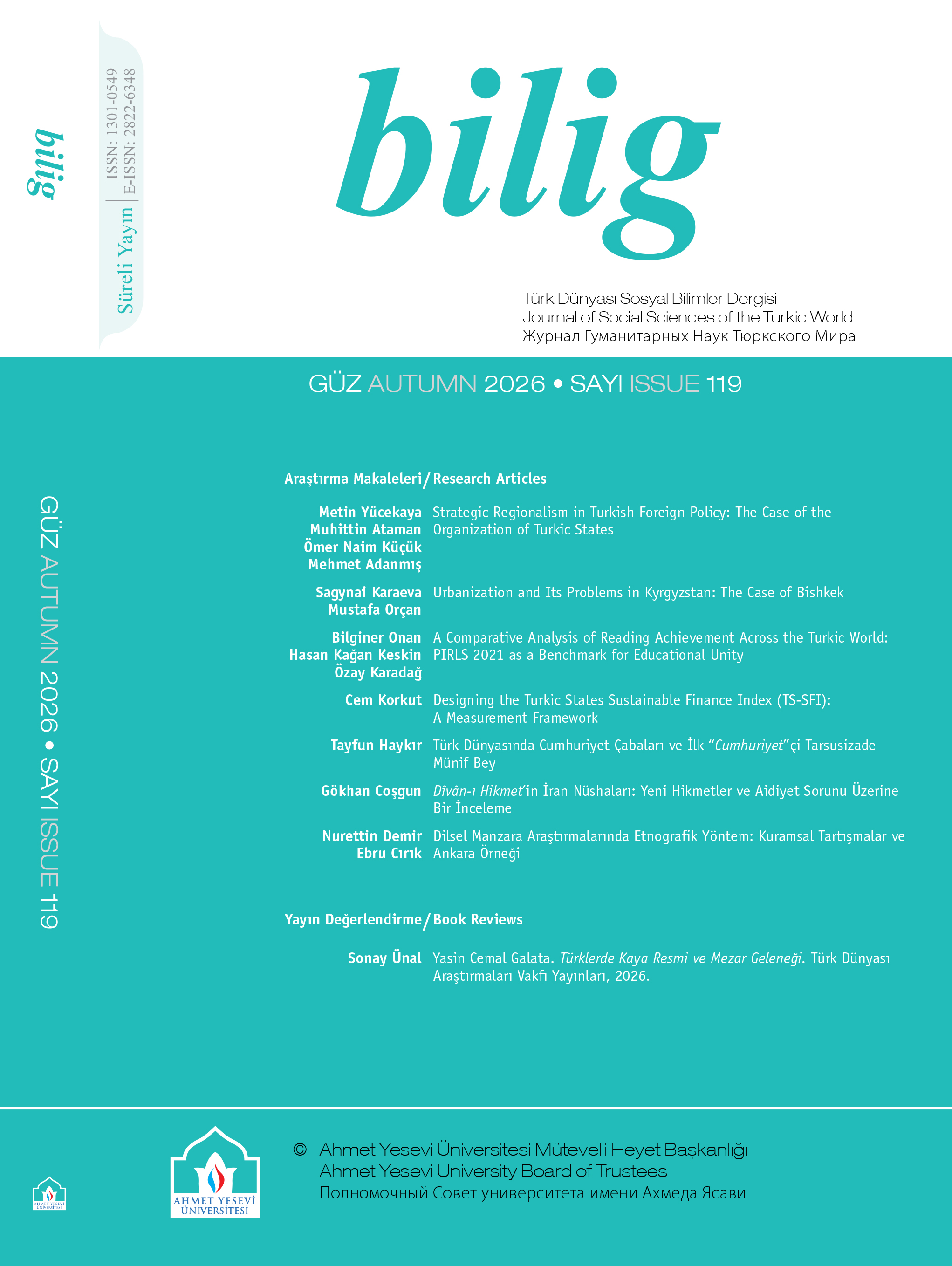
Strategic Regionalism in Turkish Foreign Policy: The Case of the Organization of Turkic States doi.org/10.12995/bilig.9518pp. 01–34
- pp. 35–72
-
A Comparative Analysis of Reading Achievement Across the Turkic World: PIRLS 2021 as a Benchmark for Educational Unity doi.org/10.12995/bilig.9616pp. 73–108
-
Designing the Turkic States Sustainable Finance Index (TS-SFI): A Measurement Framework doi.org/10.12995/bilig.9408pp. 109–150
-
Türk Dünyasında Cumhuriyet Çabaları ve İlk “Cumhuriyet”çi Tarsusizade Münif Bey doi.org/10.12995/bilig.9182pp. 151–185
-
Dîvân-ı Hikmet’in İran Nüshaları: Yeni Hikmetler ve Aidiyet Sorunu Üzerine Bir İnceleme doi.org/10.12995/bilig.9610pp. 187–224
-
Dilsel Manzara Araştırmalarında Etnografik Yöntem: Kuramsal Tartışmalar ve Ankara Örneği doi.org/10.12995/bilig.9486pp. 225–254
Book Review