Foreword
Dear Readers,
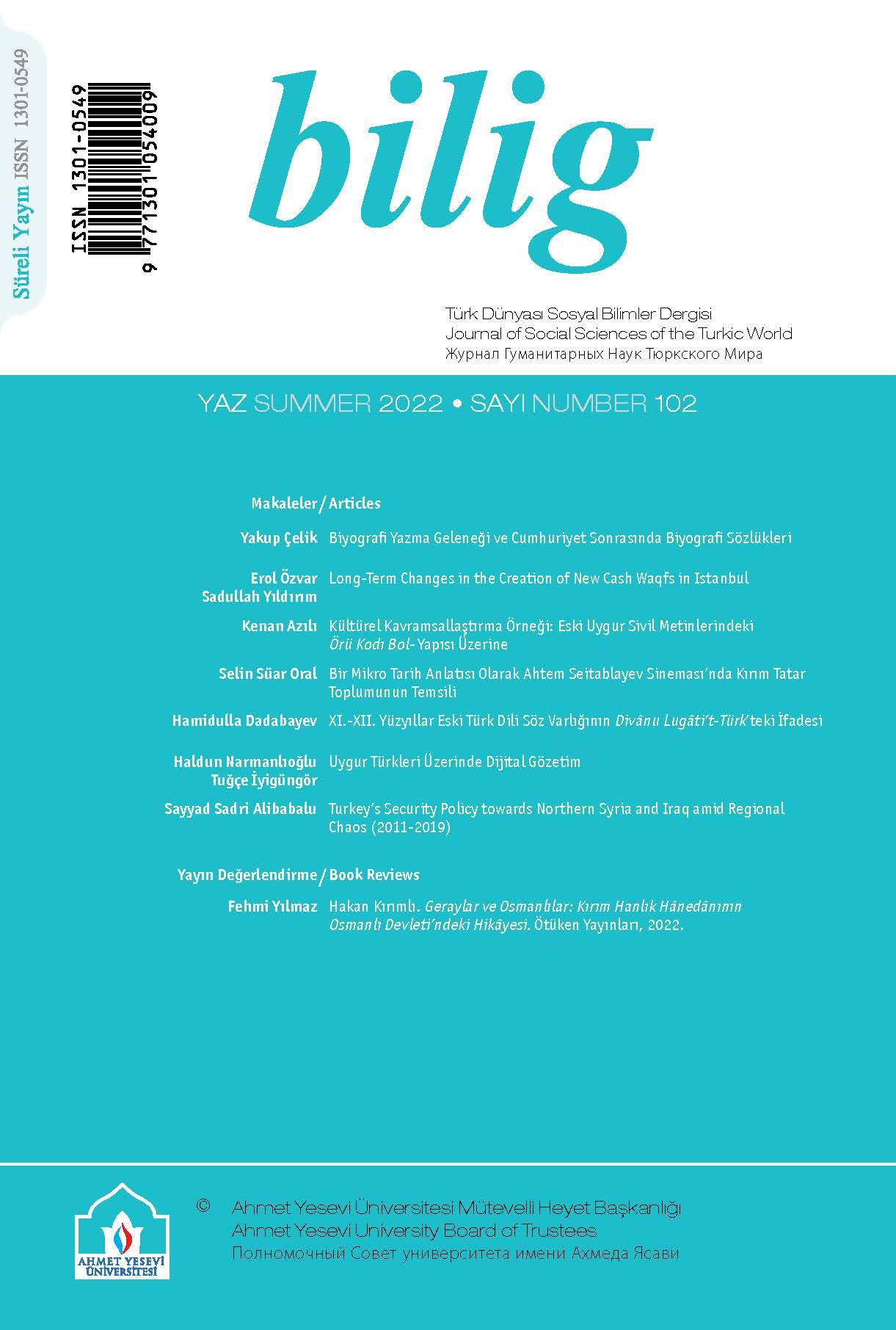
We are pleased to present the new issue of our journal to your benefit. In this issue, there are seven articles on the cultural treasures and current affairs of the Turkish world from the fields of language, history, literature, and international relations. Doyen scholars such as Prof. Dr. Erol Özvar and Prof. Dr. Yakup Çelik and young academicians such as Dr. Sayyad Sadri Alibabalu ve Tuğçe İyigüngör are among our writers. Upon reading Özvar and Yıldırım’s article, you will recognize that Turkish civilization is a foundation civilization and women had an active role in in foundation works. Çelik’s article, on the other hand, deals with the tradition of writing biographies which started with “tezkire”s in Turkish literature. Article titled “The Reflection of the lexical composition of the Old Turkic language of the 11th – 12th centuries in the Divânu Lugâti't-Turk” by Hamidulla Dadabayev, a scholar from Ali-Shir Nava’i Tashkent State University of Uzbek Language and Literature and Kenan Azılı’s article titled “A Sample of Cultural Conceptualization: On the Form of örü kodı bol- in the Old Uyghur Civil Texts” should be read together. Both articles contain significant determinations on the development and change of the Turkish language spoken by Uyghurs before and after Islam. Narmanlıoğlu and İyigüngör’s article reveals the role played by the digital surveillance established in East Turkestan, where the Uyghurs densely inhabit, which is located within the borders of the People’s Republic of China today, in erasing the ancient Turkish cultural heritage, which is a common treasure of humanity.
Dear bilig followers,
The last week of June is eagerly awaited for the journals on the Web of Science list. The Journal Citation Report, which shows the impact factor of the journals and includes other analyzes, is published each year at the end of June. As is the tradition, we share this data with you in our July issue. First, we would like to express that bilig’s position in SSCI remains stable. On the other hand, as can be seen in the chart, there is a relative decrease in bilig’s impact factor in 2021 compared to 2019 and 2020. The reasons for this decrease may be found in the article titled “Journal Citation Reports 2022: A Preview” by Marie McVeigh from Web of Science. McVeigh states that two important incidences have shaped the 2021 impact factor of the journals. Early Access content was included in the evaluation for the first time in 2020 by the Web of Science. Besides, Covid-19, which has unexpectedly come into our lives, has created a completely new and quite urgent field of work. These two incidences have given an extraordinary feature to the 2020 data, which plays a decisive role in the determination of the 2021 impact factor of the journals. While the JCR (the Journal Citation Report) has 25% more articles and citations than the previous year, they mostly are in the field of Covid-19, global crisis, and information sciences. During this period, there has been a remarkable increase in the impact factor of journals related to medicine and health sciences. In the field of social sciences, studies analyzing the changes in social life that Covid-19 has caused had a higher impact factor. As bilig Editorial Board, at the beginning of 2020, we decided not to evaluate the articles related to Covid-19 for a certain period, considering that the analyzes to be made without sufficient data would be scientifically weak and misleading. It is seen that the preference negatively affected our 2021 impact factor.
On the other hand, it is evident that we need to work harder to reach the most qualified articles and effectively deliver them to the scientific community. From now on, while continuing without compromising on quality, we will try to follow the changes and priorities in the world more closely. In this context, the Chairman of The Higher Education Quality Council of Turkey (THEQC) Prof. Dr. Muhsin Kar’s joining to our editorial board will impower bilig.
With the hope that the new issue will be useful, I wish you a good reading and present my respects.
Prof. Dr. Fırat Purtaş
Editor in Chief
Issue Details
- Issue
- 102
- Published
- Articles
- 8
- Period
- Summer 2022
Contents
8 itemsResearch Article
- pp. 1–25
- pp. 27–51
-
Kültürel Kavramsallaştırma Örneği: Eski Uygur Sivil Metinlerindeki Örü Kodı Bol- Yapısı Üzerine doi.org/10.12995/bilig.10203pp. 53–72
-
Bir Mikro Tarih Anlatısı Olarak Ahtem Seitablayev Sineması’nda Kırım Tatar Toplumunun Temsili doi.org/10.12995/bilig.10204pp. 73–96
-
XI.-XII. Yüzyıllar Eski Türk Dili Söz Varlığının Divânu Lugâti’t-Türk’teki İfadesi doi.org/10.12995/bilig.10205pp. 97–118
Research Article
- pp. 119–146
-
Turkey’s Security Policy towards Northern Syria and Iraq amid Regional Chaos (2011-2019) doi.org/10.12995/bilig.10207pp. 147–170
Book Review
- pp. 171–186