
Foreword
Dear Readers,
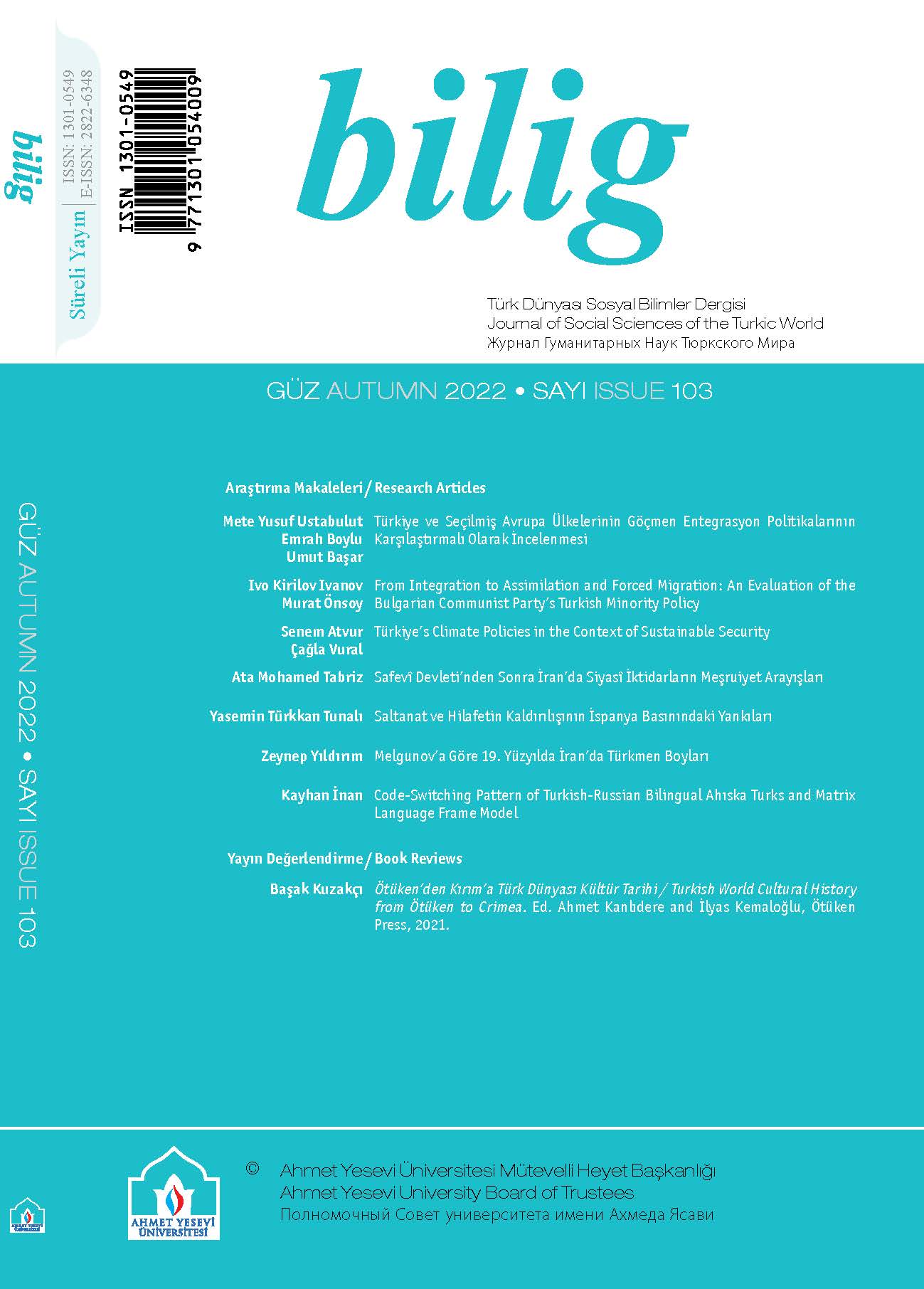
We are pleased to present the 103rd issue of bilig to you.
There are a number of articles that will certainly draw your interest in our 103rd issue which includes seven invaluable articles and a review. The period we live in is given different names such as the information age, the digital age, the metaverse age, and it is stated that perception has taken precedence over reality. On the other hand, migrations and the problems they have caused blatantly reveal the reality of life. In this respect, 21st century can also be named as the century of migrations. The change of Türkiye’s ranking in the migrant policy in line with 2015 and 2020 outputs – compared with six European countries (Germany, Belgium, France, Norway, Finland, and Sweden) – is analyzed in Ustabulut, Boylu and Başar’s article “Immigrant Integration Policy Index” (MIPEX). The article shows that while there was a significant difference between Türkiye and the aforementioned European countries in 2015 in the 2015 MIPEX report in terms of index scores, that difference declined in the 2020 report.
Dynasties of Turkish origin has ruled in Iran for many years. In the words of Russian Turcologist Barthold, it is not possible to draw a clear line between Iran and Turan. In the article titled “Searching for Legitimacy of the Political Powers in İran after the Safavid Period”, the efforts of four different Turkish dynasties – which were established in a-seventy-year period following the collapse of the Safavid State - to gain legitimacy is examined. The articles emphasizes that the Qajar Dynasty was the longest reigned of these four states as it successfully considered the principles of religious identity, paternity, geographical integrity, and military power. In another
article which deals with the Turkmen tribes in Iran in line with the report of the Russian traveler Mengulov, administrative structure, social and economic relations of the Qajar period are analyzed. We are of the opinion that reading these two articles together would be beneficial.
Climate change concerns all people as a global problem and forces countries to collaborate on this issue. Atvur and Vural’s article examines Türkiye’s climate policies within the framework of sustainable security. As for Önsoy and Ivanov’s article, the assimilation and forced migration policy of the Bulgarian Communist Party – contrary to the principles of the Socialism - against the Turkish minority is explained.
October is the time when scientific, cultural, and educational activities intensify at universities. The number of celebrations held at universities on the subject of “October 3” which has been declared as the “Turkish-Speaking Countries Cooperation Day” by the Organization of Turkish States is increasing every year. Strengthening the awareness of common identity among the youth of the Turkic world will facilitate the achievement of the vision of the future among the Turkish States. On October 29, the 99th anniversary of the foundation of the Republic of Türkiye will be celebrated with various activities in Türkiye and in its overseas representations. Hereby, we congratulate all our writers and readers whose hearts beat for Turkishness and humanity and who contribute to the construction of the “century of Türkiye” and the “century of the Turkish world” that shine like a sun on the horizon.
We hope that our October issue will be beneficial for the scientific community and that it will be a source of inspiration for original and innovative studies contributing to science.
Prof. Dr. Fırat PURTAŞ
Editor in Chief
Issue Details
- Issue
- 103
- Published
- Articles
- 8
- Period
- Autumn 2022
Contents
8 itemsResearch Article
-
Türkiye ve Seçilmiş Avrupa Ülkelerinin Göçmen Entegrasyon Politikalarının Karşılaştırmalı Olarak İncelenmesi doi.org/10.12995/bilig.10301pp. 1–30
-
From Integration to Assimilation and Forced Migration: An Evaluation of the Bulgarian Communist Party’s Turkish Minority Policy doi.org/10.12995/bilig.10302pp. 31–58
- pp. 59–93
-
Safevî Devleti’nden Sonra İran’da Siyasî İktidarların Meşruiyet Arayışları doi.org/10.12995/bilig.10304pp. 95–118
- pp. 119–148
- pp. 149–181
-
Code-Switching Pattern of Turkish- Russian Bilingual Ahıska Turks and Matrix Language Frame Model doi.org/10.12995/bilig.10307pp. 183–209
Book Review
- pp. 211–223