
Foreword
Dear Readers,
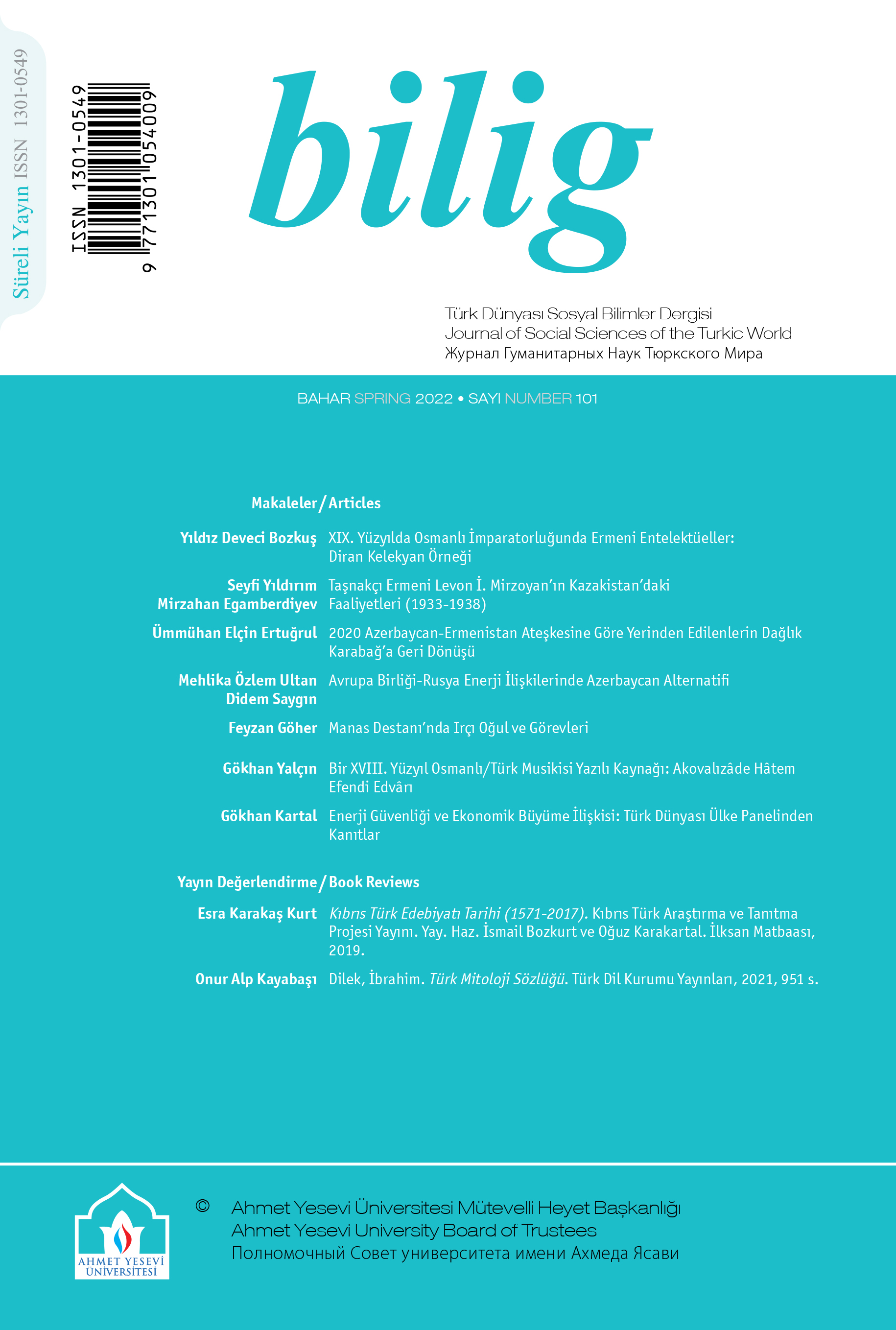
We present the 101st issue of bilig, which has 25 years of experience and a wealth of information from 100 issues.
This issue mainly includes articles that are related to Armenia.
When the articles in bilig are examined, you will notice many different dimensions of the efforts to stabilize the South Caucasus region, which started with the end of the Armenian occupation in Karabakh as a result of the Homeland War, which ended up with Azerbaijan’s victory.
Yıldız Deveci Bozkuş’s article titled “Armenian Intellectuals in the XIX. Century in Ottoman Empire” offers a constructive approach in this regard. The author presents her article as a contribution to the efforts of studying the contribution of Armenian intellectuals to the intellectual life of the Ottoman Empire to base Turkish-Armenian relations on the practice of living together, taking them out of the context of the genocide controversy. The article discusses in general terms which areas Armenian intellectuals came to the fore in the Ottoman modernization process and the works they produced in these areas and examines the life, works and contributions of Diran Kelekyan, one of the leading figures of the period, to the Turkish modernization process.
Bolshevik Armenians took an active part both in the Red Army and among the Soviet administrators during the establishment of the Soviet Union. One of them is Levon İ.Mirzoyan, worked between 1917 and 1938 to settle the Bolshevik administration in Azerbaijan, Kazakhstan, and some other regions. As Mirzoyan was an influential actor in the emergence of the Nagorno-Karabakh issue, he implemented the policy of killing or exiling Kazakh intellectuals while he was the First Secretary of the Kazakh Soviet Administration between 1933 and 1938. The article prepared by Seyfi Yıldırım and Mirzahan Egamberdiyev by utilizing the archive documents reveals striking facts about Mirzoyan’s activities in Kazakhstan between 1933 and 1938.
Ümmühan Elçin Ertuğrul, on the other hand, deals with the problem of displaced persons and refugees, which emerged with the Armenian occupation of Azerbaijani lands, from the perspective of international law. In addition, the author draws attention to the legal gaps that she has identified regarding the protection of Internally Displaced Persons. According to article 7th of the ceasefire agreement signed between Armenia, Azerbaijan, and Russia on 9 November 2020, “Internal displaced persons and refugees are returning to the territory of Nagorno- Karabakh and adjacent districts under the control of the Office of the United Nations High Commissioner on Refugees.” Ertuğrul’s article focuses on the possible problems that may be encountered during the implementation of the aforementioned article and offers solutions.
Mehlika Özlem Ultan and Didem Saygın’s article titled Azerbaijan as an Alternative to European Union-Russian Energy Relations is an analysis that reveals the benefits of the stability in the South Caucasus for the EU and the international system. As Ultan and Saygın pointed out, the course of relations between the EU and Azerbaijan over energy security relies on the EU’s stance in solving the Karabakh conflict. Azerbaijan’s natural gas reserves gain strategic importance in terms of balancing the EU’s energy dependence on Russia.
We would like to draw attention to the fact that the volume of our 101st issue, which includes seven articles in total, including three original and contributing articles in the disciplines of folk literature, music history, and economics, has shrunk compared to the previous issues. This change is a reflection of our commitment to improving the quality of our journal through publishing high-quality articles with a strong impact factor.
I would like to thank especially my authors and referees, my professors on the editorial board, and all my friends who followed the publication process, who contributed to the publication of this issue, and wish you good reading.
Prof. Dr. Fırat PURTAŞ
Editor in Chief
Issue Details
- Issue
- 101
- Published
- Articles
- 9
- Period
- Spring 2022
Contents
9 items-
XIX. Yüzyılda Osmanlı İmparatorluğunda Ermeni Entelektüeller: Diran Kelekyan Örneği doi.org/10.12995/bilig.10101pp. 1–30
-
Taşnakçı Ermeni Levon İ. Mirzoyan’ın Kazakistan’daki Faaliyetleri (1933-1938) doi.org/10.12995/bilig.10102pp. 31–56
Research Article
-
2020 Azerbaycan-Ermenistan Ateşkesine Göre Yerinden Edilenlerin Dağlık Karabağ’a Geri Dönüşü doi.org/10.12995/bilig.10103pp. 57–86
- pp. 87–114
- pp. 115–134
-
Bir XVIII. Yüzyıl Osmanlı/Türk Musikisi Yazılı Kaynağı: Akovalızâde Hâtem Efendi Edvârı doi.org/10.12995/bilig.10106pp. 135–162
-
Enerji Güvenliği ve Ekonomik Büyüme İlişkisi: Türk Dünyası Ülke Panelinden Kanıtlar doi.org/10.12995/bilig.10107pp. 163–192
Book Review
- pp. 193–198
- pp. 199–206