
Foreword
Dear Readers,
bilig is a journal, pioneer in the field of social sciences in the Turkic world. Being published uninterruptedly since 1996 and conveying the unique treasures of the Turkic intellectual world to the readers with its rich content, bilig is the product of an effort that is always updated by keeping the tradition alive. It has the purpose of being a leader and a model among the academic journals. As the member of Board of Trustees of Ahmet Yesevi University, I am delighted to be a part of such meaningful work and present the 100th issue of bilig to you.
It is admirable that Ahmet Yesevi University, which is the first international university of Turkey and Kazakhstan and was established with the mission of raising new generations that will build the future of the Turkic world, has a scientific journal scanned by internationally respected indexes, particularly SSCI and Scopus. In this respect, bilig is a journal asserting to present our perspective on language, history, literature, philosophy, sociology, and other fields of social sciences, and telling our story to the world through our imagination.
In Turkey and around the world, a Eurocentric perspective of social sciences is dominant, from historiography to international system discussions, from philosophy to literature, and from economics to social studies. Such a perspective produces results that overlook or de-subjectifies the Turkic-Islamic world. It is not possible for us to fully comprehend the richness of our cultural heritage without conducting interdisciplinary and multidimensional studies in fields like history, philosophy and literature. Platforms such as bilig have essential functions in terms of being able to develop a critical approach to the knowledge imposed by orientalism and creating an alternative philosophy of science.
In 2021, the Turkic republics have completed the 30th anniversary of their independence. At the Summit of the Turkic Council Heads of State held in Istanbul on 12 November 2021, the multilateral cooperation structure between the Turkic republics was transformed into the Organization of Turkic States. In addition to the political, economic, and commercial cooperations, many projects are also carried out in humanitarian fields under the same roof. One of them is the Union of Turkic Universities, of which Ahmet Yesevi University is the term president. The Union of Turkic Universities operates to accomplish the goals such as increasing the mobility of students and academic staff between the universities of member countries, developing joint projects, and organizing joint activities and publications. In this respect, Ahmet Yesevi University and bilig are the most promising result of science diplomacy among the Turkic states.
Activities such as establishing joint universities and institutes, awarding scholarships, and organizing summer camps, exhibitions, and festivals can be listed within the scope of science diplomacy, which can be defined as the establishment of scientific cooperation among states to address the common problems faced by humanity and to form international partnerships. Considering its establishment, goals, and activities, Ahmet Yesevi University is a successful example of science diplomacy carried out by Turkey and Kazakhstan.
While the time we live in is elapsing at a dizzying speed, developments that can only fit in a century occur just in a year. Under these conditions, conducting academic studies without abandoning critical thought and surrendering to the spirit of the age and with an approach keeping up with and being ahead of the time is crucial. Working in line with the necessities of the time without being enslaved by it and leaving the search for goodness, fairness, and truth is the formula for solutions to many social problems. From a long historical perspective, the Turks, who spread to Europe from the depths of Central Asia, have never been out of the cultural interaction and globalization. When the thousand-year-old great march is taken into consideration, it is observed that our ancestors have been in intensive interaction with different cultures, languages, religious groups, and political structures along the way, and they have built a unique base of civilization. Therefore, we stand against the threats and challenges posed by today’s globalization conditions by gaining strength from the unity.
It is impossible to establish a productive world of thought with a poor language and to find solutions to our problems with the concepts and imagination of others. As the heirs of Ahmet Yesevi, Mevlana, Yunus, and many others who have been the symbols of culture, civilization, peace, humanity, morality, generosity, and patriotism throughout history in geography that starts from the depths of Central Asia and extends to the Balkans and Central Europe; we must increase the number and the quality of our works such as bilig even more to rebuild and revive our imagination. To this respect, I celebrate the 100th issue of bilig and I wish you a good reading.
Prof. Dr. İbrahim Kalın
T.C. Presidential Spokesperson
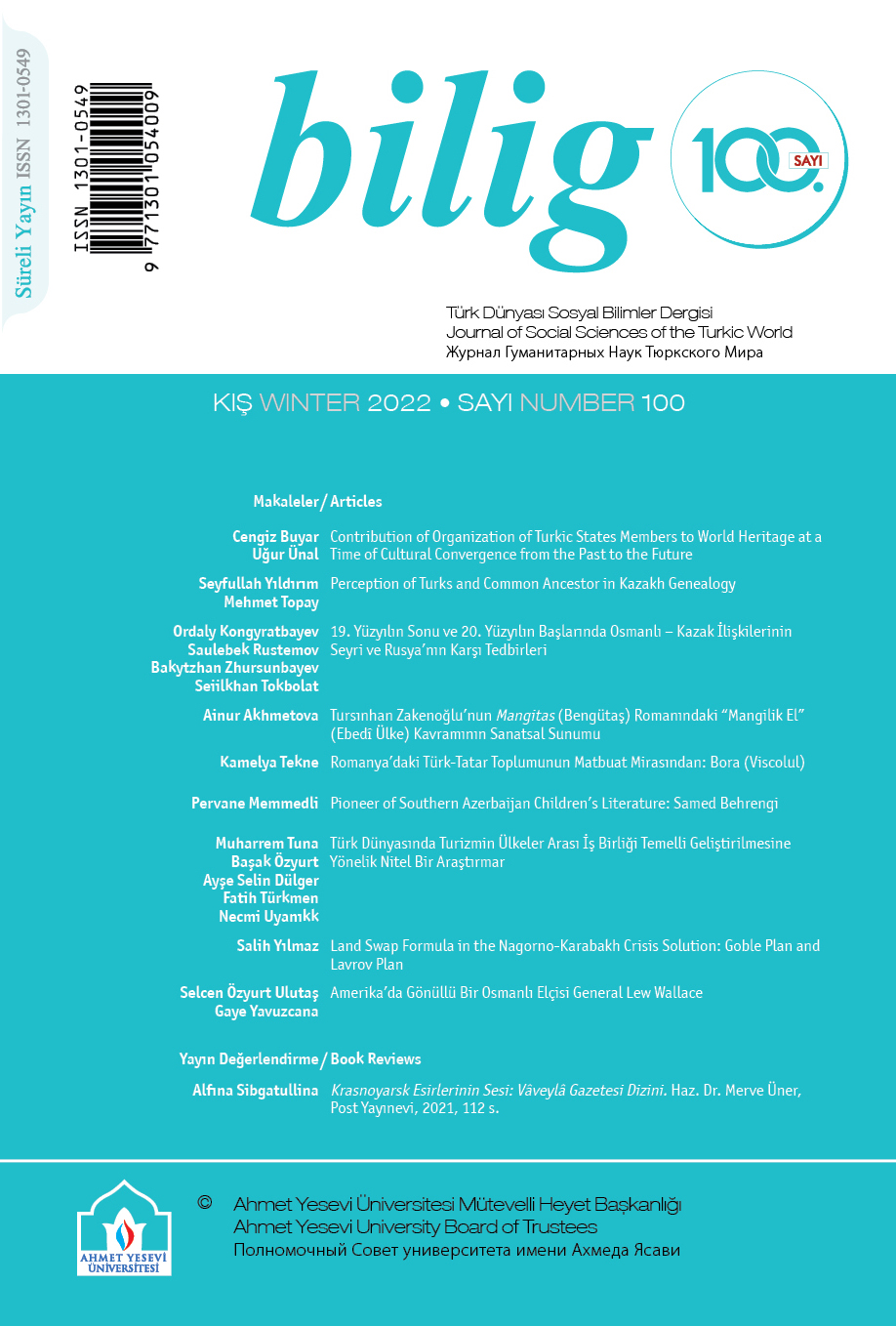
Issue Details
- Issue
- 100
- Published
- Articles
- 10
- Period
- Winter 2022
Contents
10 items-
Contribution of Organization of Turkic States Members to World Heritage at a Time of Cultural Convergence from the Past to the Future doi.org/10.12995/bilig.10001pp. 1–35
Research Article
- pp. 37–58
-
19. Yüzyılın Sonu ve 20. Yüzyılın Başlarında Osmanlı – Kazak İlişkilerinin Seyri ve Rusya’nın Karşı Tedbirleri doi.org/10.12995/bilig.10003pp. 59–75
-
Tursınhan Zakenoğlu’nun Mangitas (Bengütaş) Romanındaki “Mangilik El” (Ebedȋ Ülke) Kavramının Sanatsal Sunumu doi.org/10.12995/bilig.10004pp. 77–97
- pp. 99–122
Research Article
- pp. 123–136
-
Türk Dünyasında Turizmin Ülkeler Arası İş Birliği Temelli Geliştirilmesine Yönelik Nitel Bir Araştırma doi.org/10.12995/bilig.10007pp. 137–176
-
Land Swap Formula in the Nagorno- Karabakh Crisis Solution: Goble Plan and Lavrov Plan doi.org/10.12995/bilig.10008pp. 177–209
- pp. 211–245
Book Review
- pp. 247–252