Foreword
Dear Readers,
We are happy to present the new issue of bilig. We believe that this issue consists of valuable studies that contribute scientifically to the multidimensional integration efforts of the Turkic world, have a high impact factor and shed light on humanity.
After the collapse of the Soviet Union, Turkology and Turkic world social sciences studies have intensified and are constantly increasing both in quantity and quality. Every year, dozens of scientific events are organized and academic publications are published on Turkic world issues. On the other hand, the ever-increasing corpus and the variety of publications in different languages make it difficult to follow original and innovative studies. In this respect, the distinguished position of bilig as a means of accessing original studies in the field of social sciences in the Turkic world becomes even more important.
On April 2-3, 2025, Akhmet Yassawi University hosted the 2nd symposium on “Kazakh Language as a Language of Science”. One of the stakeholders of this symposium was bilig magazine. Within the scope of the symposium, an editors' workshop titled “Science
Diplomacy in the Turkic World” was organized by bilig. Participants from Turkey, Kazakhstan, Kyrgyzstan, and Uzbekistan participated in the workshop, where cooperation between university journals publishing in the field of Turkology was emphasized. The workshop, where issues such as developments in international indexes, especially WoS and Scopus, new trends in academic publishing, problems encountered in authorship and refereeing processes were discussed, also emphasized the need for more cooperation in this field.
As a result of the dizzying developments in information technologies, especially the threats and opportunities created by artificial intelligence, it is imperative to take action in many different areas, from the production of original content to its delivery to the relevant
people. In this context, increasing the number of scientific publications in Turkish and different dialects of Turkish is one of the issues that should be emphasized. Due to assistive technologies, translating an article into any target language has become easier. However, creating an original copyrighted work on a specific subject with the help of machines is impossible. Therefore, no matter what language it is written in, any work with a universal point of view, thinking in Turkish, seeking solutions to the rich cultural heritage of the Turkic world or its current issues is Turkish.
As a result of efforts such as the faculty training program carried out by Akhmet Yassawi University, the common higher education institution of the Turkic world, a new generation of academics is being formed in the Turkic world. The achievements of this young generation of academics, who are open to innovation and development, integrated with the world, embracing the concept of the unity of the Turkic world, realistic as well as ambitious, are extremely promising for the common future of the Turkic world. This young academic environment, which draws its strength from its deep-rooted past, constantly improves itself against the challenges of the modern world, and keeps the tradition alive with an innovative and dynamic approach, is also a guarantee for the future of bilig.
With these thoughts, we hope that our new issue will be useful and wish you pleasant reading.
Prof. Dr. Fırat PURTAŞ
Editor in Chief
Issue Details
- Issue
- 113
- Published
- Articles
- 7
- Period
- Spring 2025
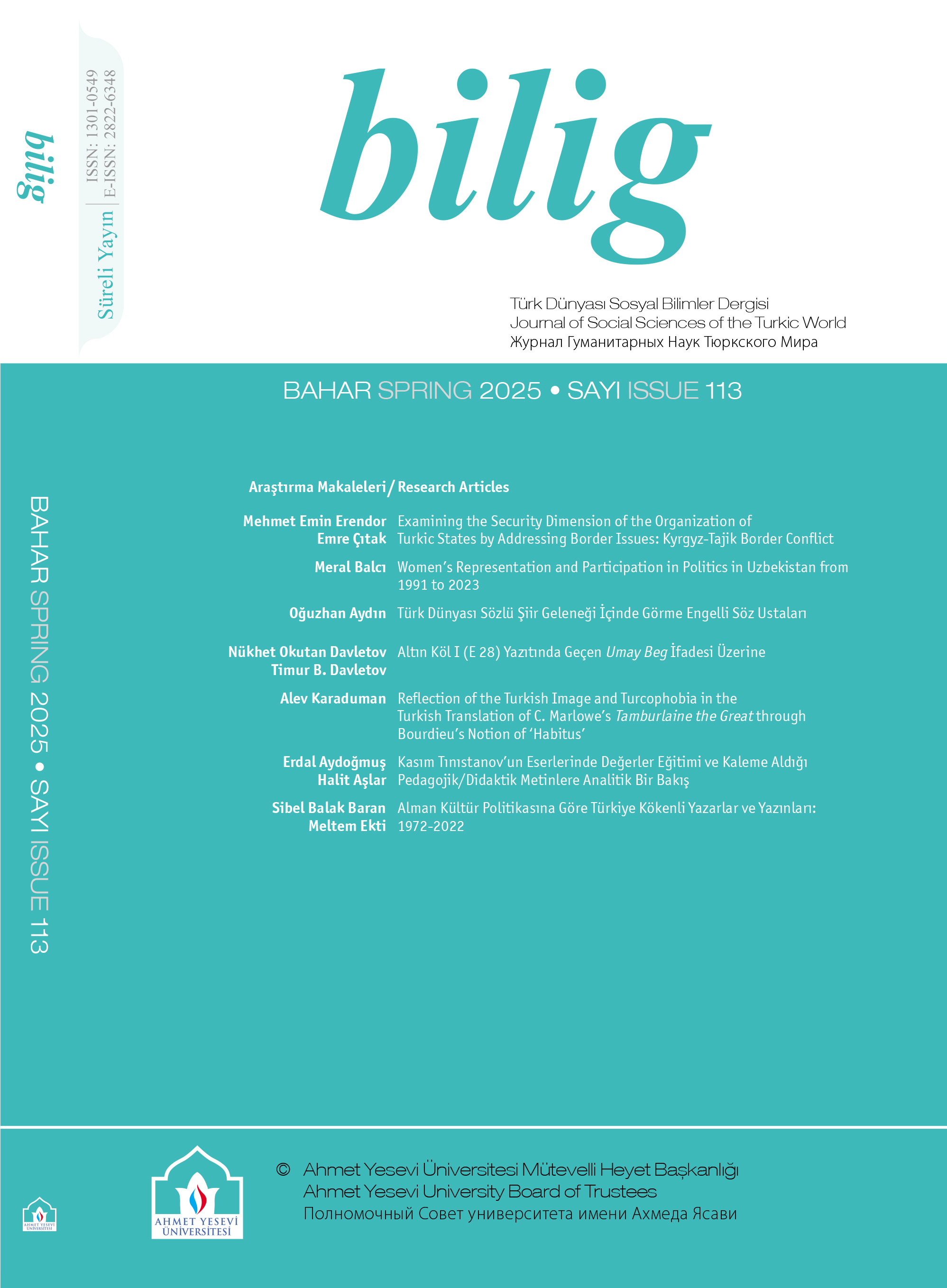
Contents
7 itemsResearch Article
-
Examining the Security Dimension of the Organization of Turkic States by Addressing Border Issues: Kyrgyz-Tajik Border Conflict doi.org/10.12995/bilig.7916pp. 1–26
-
Women’s Representation and Participation in Politics in Uzbekistan from 1991 to 2023 doi.org/10.12995/bilig.11302pp. 27–52
- pp. 53–78
- pp. 79–100
-
Reflection of the Turkish Image and Turcophobia in the Turkish Translation of C. Marlowe’s Tamburlaine the Great through Bourdieu’s Notion of ‘Habitus’ doi.org/10.12995/bilig.7342pp. 101–126
-
Kasım Tınıstanov’un Eserlerinde Değerler Eğitimi ve Kaleme Aldığı Pedagojik/Didaktik Metinlere Analitik Bir Bakış doi.org/10.12995/bilig.7478pp. 127–152
-
Alman Kültür Politikasına Göre Türkiye Kökenli Yazarlar ve Yazınları: 1972-2022 doi.org/10.12995/bilig.7678pp. 153–180