Foreword
Dear Readers,
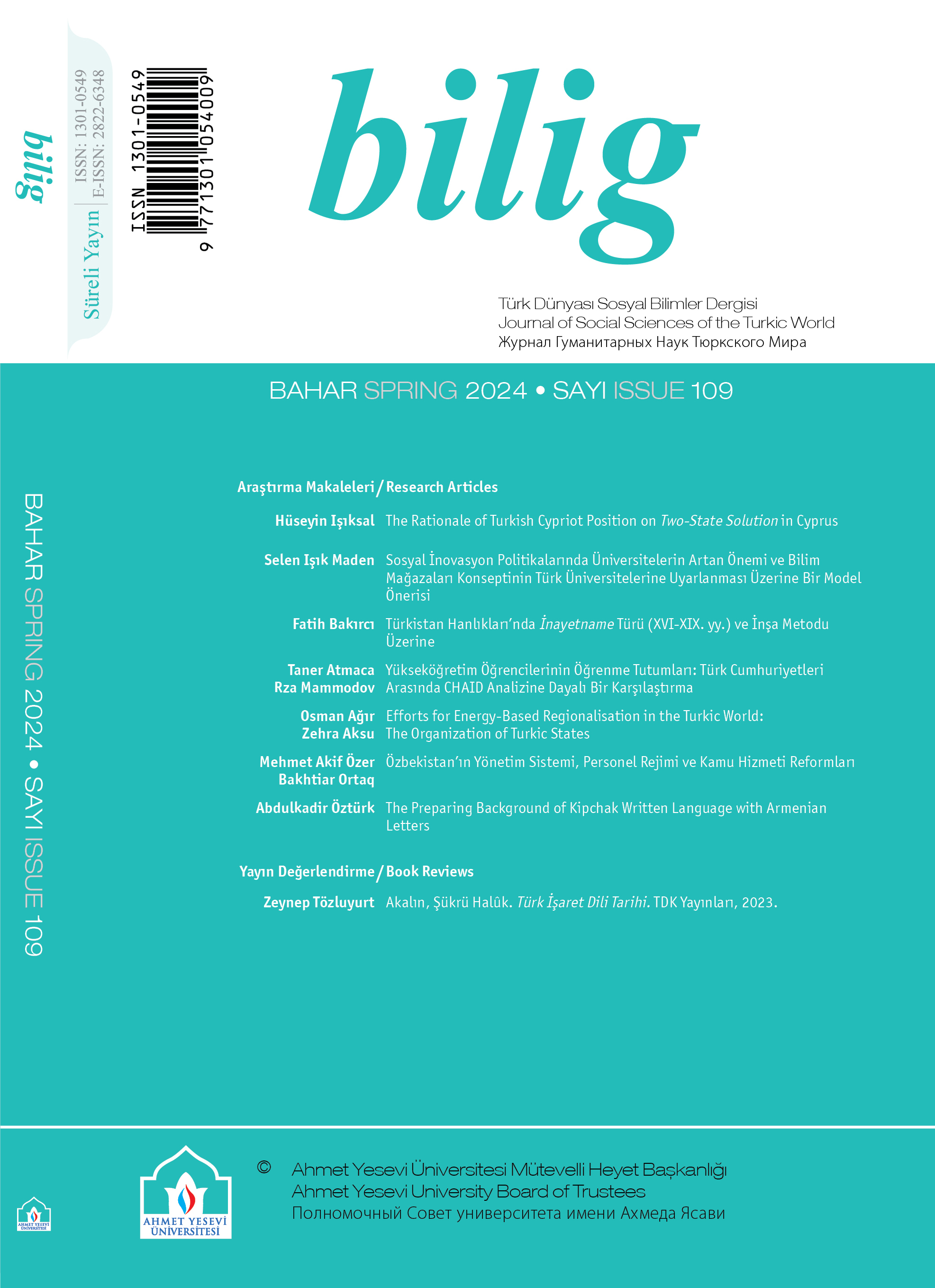
We are happy to present you the new issue of our journal. In this issue, there are seven articles addressing the cultural richness and current problems of the Turkic world from different aspects. The article written by Hüseyin Işıksal on the two-state solution formula in Cyprus is a reference for new studies on the Cyprus issue. The article on the Inayetname genre and construction method, the study on the Kipchak written language in Armenian letters, the analysis on cooperation in the field of energy in the integration of the Turkic world, the article examining the public administration and civil service regime in Uzbekistan are among the original studies that contribute to the field.
As bilig Editorial Board, while trying to increase the quality of our journal by including qualified articles on the Turkic world within the framework of the principles of objectivity and transparency, we also pay attention to follow the innovations related to scientific journalism. In this context, an Editors' Workshop on "The Role of Web of Science (WoS) Turkey-addressed Scientific Journals in Turkey's Science Diplomacy" was held on February 29, 2024, hosted by the Presidency of the Board of Trustees of Ahmet Yesevi University. 22 editors of journals indexed in the field of social sciences in WoS participated in the event organized in the National Library of the Presidential Complex and shared their experiences. As stated by Prof. Dr. Muhittin Şimşek, Chairman of the Board of Trustees of Ahmet Yesevi University, in his opening speech, the workshop was organized with the aim of creating a cooperation platform between journals that succeeded in entering WoS with their selfless efforts in the field of academic journalism and to provide mutual support for more qualified publications with high impact factor. In addition to the technical presentations of TÜBİTAK ULAKBIM Manager Mehmet Mirat SATOĞLU, Istanbul University Publications Coordinator Dr. Metin TUNÇ, Ankara Yıldırım Beyazıt University Faculty Member Dr. Abdullah DEMİR, the issues highlighted in the speeches of the participating editors have been guiding for bilig.
In the workshop, the importance of trainings to improve editorial skills was seen concretely. In order to increase the impact factor of Turkey-addressed journals, it is important not only to produce high quality publications but also to support them with computer software and sufficient metadata to ensure that they reach the readers. In addition to journals, the position of books, theses and symposium proceedings is strengthening in the WoS system. In order for Turkey to turn this change into an opportunity, it is necessary to develop the book and symposium proceedings version of the TR Index, to be included in the WoS system by professionally managing university publications, and to make efforts to scan theses and dissertations conducted in Turkey in WoS.
Artificial intelligence applications such as ChatGPT raise concerns about the future of scientific studies. The use of artificial intelligence in academic writing, which is an inevitable phenomenon, is an issue that needs to be scrutinized. The use of artificial intelligence should not be prohibited, but its ethical boundaries should be determined, and ways to utilize artificial intelligence in terms of editorial processes and international promotion of journals should be explored.
The most important result of this workshop is that the cooperation between journals published in Turkey in similar fields is not at a sufficient level. It is a fact that academic articles written in Turkey are not adequately cited in new studies in the relevant field. It is a more difficult goal for articles that are ignored in academic studies in Turkey to be cited by WoS journals published abroad. On the other hand, attracting well-known and qualified international editors, reviewers and authors to the journal will make a significant contribution.
The world has been changing rapidly. Academic journal publishing processes are also undergoing a radical change. In this period of increasing competition in every field, the cooperation among Turkish journals in WoS gains importance in order for Turkey to gain an effective position in the field of social sciences. Workshops, which provide training and experience sharing in the processes of editing, writing, and refereeing, emerge as the most effective method in developing a culture of solidarity.
I hope that the number and impact factor of WoS journals with Turkey addresses, which convey the story of Turkey, the Turkish thesis, and the perspective of Turkish scientists to the world, will increase.
Prof. Dr. Fırat Purtaş
Editor in Chief
Issue Details
- Issue
- 109
- Published
- Articles
- 8
- Period
- Spring 2024
Contents
8 itemsResearch Article
-
The Rationale of Turkish Cypriot Position on Two-State Solution in Cyprus doi.org/10.12995/bilig.10901pp. 1–22
-
Sosyal İnovasyon Politikalarında Üniversitelerin Artan Önemi ve Bilim Mağazaları Konseptinin Türk Üniversitelerine Uyarlanması Üzerine Bir Model Önerisi doi.org/10.12995/bilig.10902pp. 23–44
-
Türkistan Hanlıkları’nda İnayetname Türü (XVI-XIX. yy.) ve İnşa Metodu Üzerine doi.org/10.12995/bilig.10903pp. 45–66
-
Yükseköğretim Öğrencilerinin Öğrenme Tutumları: Türk Cumhuriyetleri Arasında CHAID Analizine Dayalı Bir Karşılaştırma doi.org/10.12995/bilig.10904pp. 67–104
-
Efforts for Energy-Based Regionalisation in the Turkic World: The Organization of Turkic States doi.org/10.12995/bilig.10905pp. 105–128
-
Özbekistan’ın Yönetim Sistemi, Personel Rejimi ve Kamu Hizmeti Reformları doi.org/10.12995/bilig.10906pp. 129–158
-
The Preparing Background of Kipchak Written Language with Armenian Letters doi.org/10.12995/bilig.10907pp. 159–175
Book Review