

Abstract
The erosion of the Western-led international order and the resurgence of great power competition in the last decade have led to a more fragmented international system, rendering regional cooperation more significant. This study offers an analytical framework by expanding the concept of strategic regionalism to address Türkiye’s growing interest in regional international organizations. Strategic regionalization is defined as a hybrid foreign policy strategy that integrates tools such as economic cooperation and identity proximity with high-politics goals. Accordingly, regional organizations are not merely platforms for economic integration; they also serve as tools to enhance the geopolitical interests of states and broaden the scope of global activity. The study employs two complementary methods. By employing a unique dataset covering Türkiye’s interactions with international organizations and the Organization of Turkic States as a case study, this study shows that, firstly, Türkiye assumed a facilitating role rather than a hegemonic or supportive leadership role in regional organizations, adopting an approach that prioritizes sovereign equality and consensus. Secondly, with this hybrid regionalization model, Türkiye is pursuing a policy similar to that of other regional powers and middle powers, while at the same time producing a novel and ambitious policy in terms of motivations and objectives.
Öz
Türk Dış Politikasında Stratejik Bölgeselleşme: Türk Devletleri Teşkilatı Örneği
Batı öncülüğündeki uluslararası düzenin aşınması ve son on yılda büyük güç rekabetinin yeniden yükselmesi, uluslararası sistemi daha parçalı hâle getirmiş ve bölgesel iş birliğini daha önemli kılmıştır. Bu çalışma, stratejik bölgeselcilik kavramını genişleterek Türkiye’nin bölgesel uluslararası örgütlere artan ilgisini açıklayan analitik bir çerçeve sunmaktadır. Stratejik bölgeselleşme; ekonomik iş birliği ve kimlik yakınlığı gibi araçları yüksek politika hedefleriyle birleştiren hibrit bir dış politika stratejisi olarak tanımlanmaktadır. Buna göre bölgesel örgütler yalnızca ekonomik entegrasyon platformları değil, aynı zamanda devletlerin jeopolitik çıkarlarını güçlendiren ve küresel faaliyet alanlarını genişleten araçlar olarak işlev görmektedir. Çalışma birbirini tamamlayıcı iki yöntem kullanmaktadır. Türkiye’nin uluslararası örgütlerle etkileşimlerini kapsayan özgün bir veri setini ve bir örnek olay incelemesi olarak Türk Devletleri Teşkilatı’nı kullanan bu çalışma, ilk olarak Türkiye’nin bölgesel örgütlerde hegemonik veya destekleyici bir liderlik rolünden ziyade kolaylaştırıcı bir rol üstlendiğini; egemen eşitlik ve uzlaşıyı önceleyen bir yaklaşım benimsediğini göstermektedir. İkinci olarak Türkiye, bu hibrit bölgeselleşme modeliyle diğer bölgesel ve orta ölçekli güçlere benzer bir politika izlerken, motivasyonları ve hedefleri bakımından özgün ve iddialı bir strateji geliştirmektedir.
Makale Metni
Introduction
The first quarter of the twenty-first century witnessed a profound tectonic shift in the structure of international relations. The gradual erosion of the liberal post-Cold War order, coupled with the resurgence of great power competition between the U.S. on the one side and China and a revisionist Russia on the other side, overrode the unipolar moment in international politics. In this increasingly fractured and multi-centric international order, the conventional binary strategic choices, either aligning with the West or turning one’s face to the East, have proven insufficient, inefficient, and unsatisfactory for many actors seeking to preserve and enhance their national interests. In particular, actors labeled as middle powers feel such dissatisfaction and raise their voices against the major actors that force them to choose sides. These states seek to establish their own regional geopolitical weight, rather than relying on the security and limited autonomy provided by hegemonic blocs.
Türkiye represents one of the prime examples of this paradigmatic shift in international politics. Historically defined by its function as a flank state within the Euro-Atlantic security architecture during the Cold War, Türkiye has, over the last two decades, engaged in a radical reconfiguration of its foreign policy. In the last decade, this transformation has moved beyond mere search for new markets and creation of new social roles in international relations. It is now an expressed quest for strategic autonomy, implying the building of the necessary capacity to determine and pursue national interests without total reliance on external powers. While much of the existing academic literature has attempted to categorize this shift through the lenses of “neo-Ottomanism,” “shift of axis,” or a drift toward “Eurasianism,” these labels often fail to capture the structural nuance and the sophisticated methodology of Ankara’s approach (Erşen; Uzer; Tüysüzoğlu; Koçak and Akgül). They often conflate ideological rhetoric with strategic practice.
Structural transformation and the pursuit of strategic autonomy in Turkish foreign policy find their most prominent and concrete expression in its regionalist policies and the construction of a new generation of regional international organizations. Türkiye has not confined this methodological innovation in its foreign policy to bilateral relations or diplomatic discourse; it has begun to actively utilize institutional mechanisms to respond to geopolitical shocks in its region. Therefore, this process is not merely ideological nostalgia, but rather a practical ground where regional cooperation processes are institutionalized in a way that enhances the state’s strategic capacity and resilience. Türkiye’s practice of reimagining and reframing regional organizations as foreign policy instruments and its conduct within them necessitate an explanation beyond the narrow frameworks offered by the existing literature, requiring a more comprehensive and rational theoretical framework. Within this framework, we ask: What strategic logic shapes Türkiye’s increasing role in regional international organizations, and how is this logic reflected in its diplomatic behavior within these organizations?
This study proposes an expanded and modified “strategic regionalism” framework to answer this question and comprehend the regionalist strategy of Türkiye over the last decade. Strategic regionalization is a pragmatic and multifaceted geopolitical tool used by nation-states and corporate actors not only for economic integration but also to reshape global and regional power balances in their favor (Morales-Fajardo 21; Scott; Gilson 151). This concept combines the large corporations’ efforts to establish strategic dominance and comparative advantages in international markets to achieve joint leadership and collective security management by using the region as a strategic and operational platform. As seen in the examples of East Asia and Europe, high-level political goals such as containing rivals, maintaining the presence of allies in the region, and exporting stability to crisis zones through cross-border collaborations constitute the fundamental geopolitical motivations of this regionalization model (Gilson 163). Consequently, strategic regionalization is a flexible governance and balancing strategy aimed at increasing security, political influence, and market share in uncertain global conditions, where national interests are institutionalized at a regional level (Morales-Fajardo; Gilson).
Strategic regionalism, in our definition, implies a regionalism approach that utilizes multi-dimensional, identity or economy-based functional tools of the “New Regionalism Approach” to secure and advance the objectives of “high politics,” including security, autonomy, and global influence. Unlike the state-centric military pacts of the Cold War or the purely market-driven integration of the 1990s, this model represents a conscious synthesis. It treats “region” not as a given geographical reality or a normative goal, but as a constructed geopolitical entity. Using identity proximity and functional connection, the state builds a resilient regional network that acts as a power multiplier in the international arena. Strategic regionalism embraces the participatory and flexible mechanisms of New Regionalism while repositioning the state as the primary architect of integration. Here, soft power elements such as shared culture, language, and trade are strategically used to create a “security community” that functions without the rigidity of traditional alliances. This model of regionalism exemplifies the hybridity that is unique to the current post-hegemonic (Western) global politics.
Through this analytical lens, this study examines Türkiye’s relations with international organizations by employing two distinct methodological approaches. First, by leveraging a novel hand-coded dataset, this study examines emerging trends in Türkiye’s intergovernmental organization (IGO) memberships in a timeframe spanning from 1923 to 2023. This dataset is particularly useful to understand changing trajectories and continuities in the Justice and Development Party (AK Party) era. Second, this study expands its qualitative lenses by meticulously inspecting the role of Türkiye within the Organization of Turkic States (OTS) in a case study context. Founded as a loose cooperation council in 2009 and upgraded to a full-fledged international organization in 2021, the OTS serves as the primary platform for Türkiye’s new regionalist strategy.
Our purpose is not to displace these readings but to bring them together. Much of this literature looks at the organization through one functional lens at a time, or describes its institutional growth without tying it back to Türkiye's wider strategy. An account that treats the economic, cultural, and security dimensions as parts of a single, deliberate regional strategy is still uncommon. That is the gap we address. Instead of reading the OTS as a self-contained instance of Turkic cooperation, we treat it as the institutional vehicle through which Türkiye puts its strategic regionalism into practice, and we draw on the findings of this literature as evidence for that larger claim rather than as background.
The central argument in this paper is threefold. First, concerning motivation, Türkiye’s engagement in international organizations such as the OTS is driven by the imperative of diversification in foreign policy and building diplomatic support bases for this goal. Second, Türkiye employs the tools of New Regionalism, including identity proximity, mutual economic interests, and geographical connectivity, rather than the coercive military pacts of the past. Third and most importantly, Türkiye deliberately avoids the hegemonic, hierarchical, and conditionality-based models employed by other global actors in its approach to the functions of regionalism and international organizations. Instead, drawing on our network analysis and elite interviews, we demonstrate that Türkiye operates as an initiator and facilitator that prioritizes sovereign equality, consensus, and egalitarianism in regional organizations.
Theoretical Framework: From New Regionalism to Strategic Autonomy
To understand the unique character of Türkiye’s contemporary regionalism strategy comprehensively, it is essential to consider it within a dual context: the historical transformation of regionalism theory from rigid security blocs to flexible networks and the structural transformation of Turkish foreign policy itself. Consequently, the intellectual framework of this study is built upon the dynamic intersection of the “New Regionalism Approach” (NRA) and Ankara’s overall quest for strategic autonomy. The unique logic of Türkiye’s behavior becomes understandable precisely at this point of intersection, where the structuralist tools of region-building meet realist goals for the survival of the state.
The Evolution of Regionalism
The notion of regionalism has undergone significant transformations since 1945. The so-called “Old Regionalism,” which was the defining characteristic of the Cold War, was distinguished by bipolarity. NATO, the Warsaw Pact, the Central Treaty Organization (CENTO), or the Southeast Asia Treaty Organization (SEATO), a pioneer regional organization of the Cold War, were all top-down, state-centric, and protectionist structures. These organizations were mainly security arrangements and were designed to attach the regional actors to the sphere of influence of one of the superpowers (Ethier; Hettne and Söderbaum "New Regionalism Approach"). In this model, regions were geopolitical theaters, defined by the threats they were meant to contain rather than autonomous complexes that feature unique localities.
The end of the Cold War brought an end of those attempts at regionalism and triggered a new wave of regionalism in a novel style. Hettne and Söderbaum theorized this new wave of regionalism as the NRA and argued that this new wave is fundamentally different in logic and structure from the previous waves. This new regionalism is multidimensional, encompassing not only military security but also economic, cultural, and environmental integration. It is a porous process, driven by globalization rather than protectionism and bottom-up involving non-state actors, civil society, and market forces (Hettne and Söderbaum, “The New Regionalism” 3). Most importantly, the theorists of the NRA argue that regions are not given geographical entities but are constructed through social interaction of participant actors, which is called “regionness” (Hettne and Söderbaum, “Theorising” 460; Väyrynen 27).
Trajectory of Regionalism in Turkish Foreign Policy
Embracing this novel landscape, Türkiye significantly transformed its regional strategies, mirroring the trajectories of similar rising powers in the global system. Although a theoretical shift was desired in the 1990s, this process progressed slowly due to terrorism, instability, and cross-border security threats in Türkiye’s immediate vicinity, and foreign policy remained largely security-oriented. However, with the Justice and Development Party’s (AK Party) rise to power in 2002, the new agenda in the context of regionalism became much more concrete and distinct. While economic liberalization and the vision of becoming a trading state (Kirişci 42-52) formed the main driving force of this new era, historical and identity-based rapprochements that emerged with the dissolution of the rigid political blocs of the Cold War also served as a critical catalyst, accelerating the integration process. Thus, Türkiye shifted to a liberal-functionalist regionalism focused on de-securitizing its borders and creating mutual economic interdependence (Aras; Kardaş).
However, the post-2011 geopolitical landscape, marked by the Arab Spring, the Syrian civil war, and the deterioration of relations with the West, necessitated a third evolution. The “zero problems” policy collapsed under the weight of hard security realities. Yet, Türkiye did not simply revert to the Cold War mindset. Instead, Ankara began to pursue, as Öniş and Yılmaz (8) and Yeşiltaş (96) respectively argue, a proactive foreign policy and “strategic autonomy.” This current phase blends the activism of the 2000s with a hard-power edge.
Before turning to the strategic logic behind Türkiye's regionalism, it is necessary to clarify its place in the middle-power literature. Türkiye behaves in ways that are conventionally associated with middle powers, but its motivations and objectives increasingly go beyond the limits of classical middle-power diplomacy, which is usually defined by multilateralism, mediation, coalition-building, and norm entrepreneurship (Öniş and Yılmaz; Kutlay and Öniş; Dal and Kurşun). Recent Türkiye-focused scholarship has tried to capture this tension through qualified labels (Oğuzlu; Altunışık). Oğuzlu, for example, describes an “over-ambitious” or “restrained” middle power that is nevertheless determined to become a regional power with longer-term great-power horizons (674-675), while Ataman et al. characterize Türkiye as an “initiator state” whose activism in founding international organizations reflects a higher level of engagement than membership alone (90-93). What these accounts share is the observation that Türkiye no longer restricts itself to the risk-averse, status-quo posture of the traditional middle power. Instead, it pursues an assertive and security-conscious agenda (Yeşiltaş) of region-building, which the “Türkiye Axis” vision presents as the pursuit of an autonomous foreign policy actor (Ataman et al.).
Our framework builds on this point. We do not treat strategic regionalism as evidence that Türkiye has abandoned its middle-power identity. Rather, we argue that it is the institutional mechanism through which Türkiye tries to move beyond the conventional ceiling of middle-power activism. By building and anchoring a regional organization, Ankara turns its otherwise diffuse activism in the Middle East, Africa, the Balkans, the Caucasus, and the Turkic world into a more durable geopolitical asset that extends its diplomatic weight beyond its immediate neighborhood (Türbedar; Kutlay and Öniş). Understood in this way, Türkiye is not a classical middle power but an ambitious actor whose regionalism is meant to strengthen both its regional standing and its global bargaining position.
Strategic Regionalism (SR) emerges as a synthesis of these trends. Acknowledging the political mechanism (e.g., institutional flexibility, identity-based cooperation, and creating economic networks) introduced by the NRA, the SR reinserts the strategic logic and motivations of reelpolitik. In this model, a region is not only a market for goods or ideas but also a strategic asset. Within this framework and based on our empirical study, Türkiye utilizes regional international organizations that the country attaches great importance to, not merely as multilateral platforms but also to amplify its regional and global power. The SR framework explains Ankara’s new foreign policy approach, in which it can transform soft power tools such as identity, proximity, and comparative economic maturity into tools of geopolitical rebalancing.
Since strategic regionalism draws on several neighboring traditions, its analytical boundaries need to be specified. The concept differs from new regionalism because it brings high-politics motivations, such as security, autonomy, and global influence, back into what the New Regionalism treated mainly as a market- and society-driven process. It also differs from strategic autonomy. Autonomy refers to a structural condition or an end-state that a state seeks to reach (Yeşiltaş; Öniş and Yılmaz), while strategic regionalism refers to the institutional instrument through which that condition is pursued. Nor can it be reduced to hedging. Hedging describes a mostly dyadic, risk-diversifying posture toward competing great powers (Wicaksana and Karim). Strategic regionalism, in contrast, is a constructive and institution-building practice that creates an autonomous cooperative vector, rather than one that only balances between existing powers.
Two further distinctions are useful here. Unlike post-hegemonic regionalism, which describes a systemic condition (Hettne), strategic regionalism points to the agency and strategic intent of the state itself. It also differs from regional power politics and classical middle-power diplomacy, because it emphasizes the deliberate construction of a region as a strategic platform, and not the management of a region that already exists. We argue, finally, that strategic regionalism is a generalizable framework that can in principle apply to other middle and regional powers, even if Türkiye is a particularly instructive case. Its imperial legacy, NATO membership, maturing defense industry, Turkic identity networks, and central location between Europe, the Middle East, the Caucasus, and Central Asia give it an unusually rich set of assets for putting the strategy into practice.
Data and Methodology
This study aims to examine Türkiye’s relations with regional international organizations through the lens of the SR framework by particularly focusing on the changing trends and continuities during the AK Party era. Hence, the study capitalizes on two different data sources. First, we compiled a novel dataset, presenting an extensive snapshot of Türkiye’s relations with international organizations. The data is coded through meticulous examination of the international organizations’ own sources, the Union of International Associations’ (UIA) yearbook on international organizations, and the Turkish Ministry of Foreign Affairs’ website providing information on Türkiye’s membership in international organizations (Yearbook of International Organizations; Republic of Türkiye Ministry of Foreign Affairs). These sources ensure a broad and accurate account of Türkiye’s participation in global and regional bodies.
This comprehensive dataset covers the full history of Türkiye’s IGO engagements, capturing both historical and recent trends in membership. We detected 138 international organizations in which Türkiye established a significant formal relationship in a period spanning from 1923 to 2024. Out of these 138 IGOs, Türkiye held membership status in 121 of the organizations, participated as an observer in 13, and sustained a dialogue partnership in 4. Out of these 138 IGOs, 124 of them are still actively operating, whereas 14 have been either terminated or have started operating under a different organization. For each IGO, the dataset records Türkiye’s membership status (e.g., full member, observer, dialogue partner), whether Türkiye was a founding member or initiator of the organization, the IGO’s primary theme/purpose (categorized as economic, technical, security, or identity-focused), its geographic scope (global vs. regional organization), and whether Türkiye engages in high-level participation (i.e., sending top-level officials to its conferences). Each organization’s primary theme is coded according to its most salient purpose of cooperation as stated in its founding document; for instance, organizations whose founding charters foreground economic cooperation are coded as economic, whereas those foregrounding cultural or ethnolinguistic affinity are coded as identity-focused. Founding member status is coded based on Türkiye’s presence as a signatory to the founding document, while initiator status follows a political rather than legal conceptualization, denoting instances in which Türkiye provided the active political and economic endorsement that mobilized support for the organization’s establishment. Observer and dialogue partner status are coded in accordance with each organization’s own official designation of Türkiye in its statutory and membership records. These variables allow analysis of Türkiye’s role and emphasis in different types of organizations. These data provides insights into major trends in Türkiye’s IGO memberships, including changing trajectories in the country’s relationships with them before and after the AK Party era. In addition to the fundamental features of the organizations, we collected the formal IGO-to-IGO relations data for the IGOs in which Türkiye is a member, leveraging the UIA’s database containing information on the formal associations between the organizations. This approach enabled us to build network data for the IGOs that include Türkiye’s membership, which in turn contributed to understanding the quality and quantity of the association between the IGOs that have a formal relationship with Türkiye.
Second, we conducted elite interviews with the top diplomats in the Organization of Turkic States (OTS) to strengthen the quantitative and exploratory insights derived from the compiled dataset. The reason for selecting OTS diplomats in the interview sample is twofold. First, the OTS is one of the most influential regional organizations to which Türkiye attaches great political importance. The headquarters of the organization is in Istanbul. Türkiye’s president, Recep Tayyip Erdoğan, attaches significance to attending the annual meetings of the organization, and Türkiye mobilizes vast political efforts to play a substantial initiator role within the organization aimed at setting the agenda and drawing the organizational road map of the entity. Second, the OTS and its associated organizations, such as the International Organization of Turkic Culture (TÜRKSOY) and the Parliamentary Assembly of Turkic States (TÜRKPA), emerge as an important node in the network of regional organizations with formal associations with Türkiye (Akıllı). The OTS has exhibited the capacity to establish diplomatic contacts with other regional organizations such as the Organization of Islamic Cooperation (OIC), the Economic Cooperation Organization (ECO), and the Organization of the Black Sea Economic Cooperation (BSEC), which also occupy an important role in Türkiye’s regional foreign policymaking. The centrality of the OTS renders it a suitable candidate for a case study aimed at understanding Türkiye’s novel assertive foreign policy approach through its interactions with IGOs. As with any elite interview sample drawn from officials embedded within the institution under study, our OTS interviewees may be inclined to emphasize narratives of consensus, sovereign equality, and non-hegemonic cooperation consistent with the organization’s official self-presentation. We treat this potential institutional bias as a limitation to be read alongside, rather than resolved by, the dataset; the interviews’ primary value lies in the insider perspective they offer into the organization’s internal functioning, drawn from diplomats directly responsible for its day-to-day operation, which documentary sources alone cannot capture.
This study capitalizes on a variety of methodologies to analyze the compiled data. To begin with, exploratory data analysis (EDA) modalities are employed to understand the current and the previous trends in Türkiye’s relations with IGOs and aim to showcase both change and continuity. In addition to EDA, this study uses a network analysis methodology to reveal the formal connections of the IGOs with an official relationship with Türkiye. The network analysis methodology proved useful in fulfilling two important objectives of this study. First, exhibiting formal associations between organizations can provide insight into the extent of connectivity between IGOs, as well as help pinpoint the most important IGOs within the network of organizations. These IGOs can be influential and important simply because of the high frequency of connections with other IGOs. However, their significance can also be derived from their centrality within the network, which facilitates connections between other IGOs. This approach enables us to understand which regional or global organizations play a central or peripheral role within the network of IGOs. Second, network analysis is useful to detect the communities of closely knit IGOs whose level of connectivity distinguishes them significantly from other IGOs within the network (Luke). This approach is particularly useful to understand the extent of associations among IGOs constituting a community and provide insights into how their peculiar association should be examined qualitatively. Finally, this research employs elite interviews conducted with top diplomats of the OTS. The insight derived from the interviews has been used to triangulate the data compiled from the other sources, further strengthening the validity of the analysis.
Drivers of Strategic Regionalism: Diversification, Economy, and Autonomy
The drive behind Türkiye’s ardent commitment to the OTS extends far beyond the romanticism of shared ethnicity and cultural affinity. We argue that Türkiye’s motivation is a calculated response to structural constraints and fluctuations of the international system and is driven by four interlocking imperatives: diversification in foreign policy, pursuing economic growth through trade and economic integration, the quest for a legitimation base for its global policies, and the search for new markets for its newly developing autonomous defense industry.
Foreign Policy Diversification as a Survival Strategy
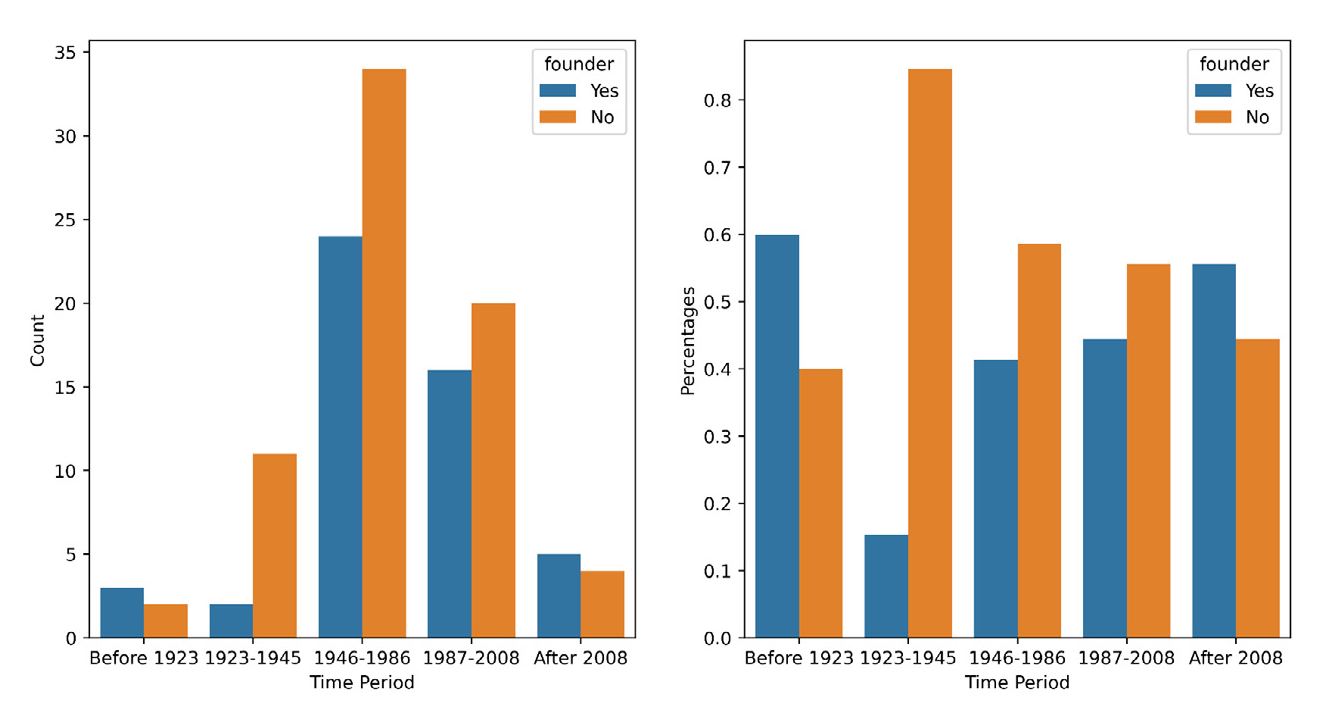
The quantitative nature of Türkiye’s relations with IGOs has varied since the foundation of the republic. The number of Türkiye’s new memberships in IGOs unsurprisingly fluctuates in different time periods, dependent upon not only Ankara’s intention to join the prevailing institutions but also the presence of new IGOs that are available for Türkiye’s participation. Notwithstanding variance in this trend, as can be seen in Figure 1, Türkiye’s proactive involvement in creating organizations has increased over time, especially since the late 1980s. Overall, Türkiye has served as a founding member in 50 of the 124 IGOs in which it is a member, approximately 41 percent of the joined IGOs, indicating a strong tendency to be present at the creation of new institutions. The share of Türkiye’s IGO engagements that involve a founder role has constantly risen in each indicated historical period.
Figure 1. Distribution of Türkiye’s IGO membership by its founder status.
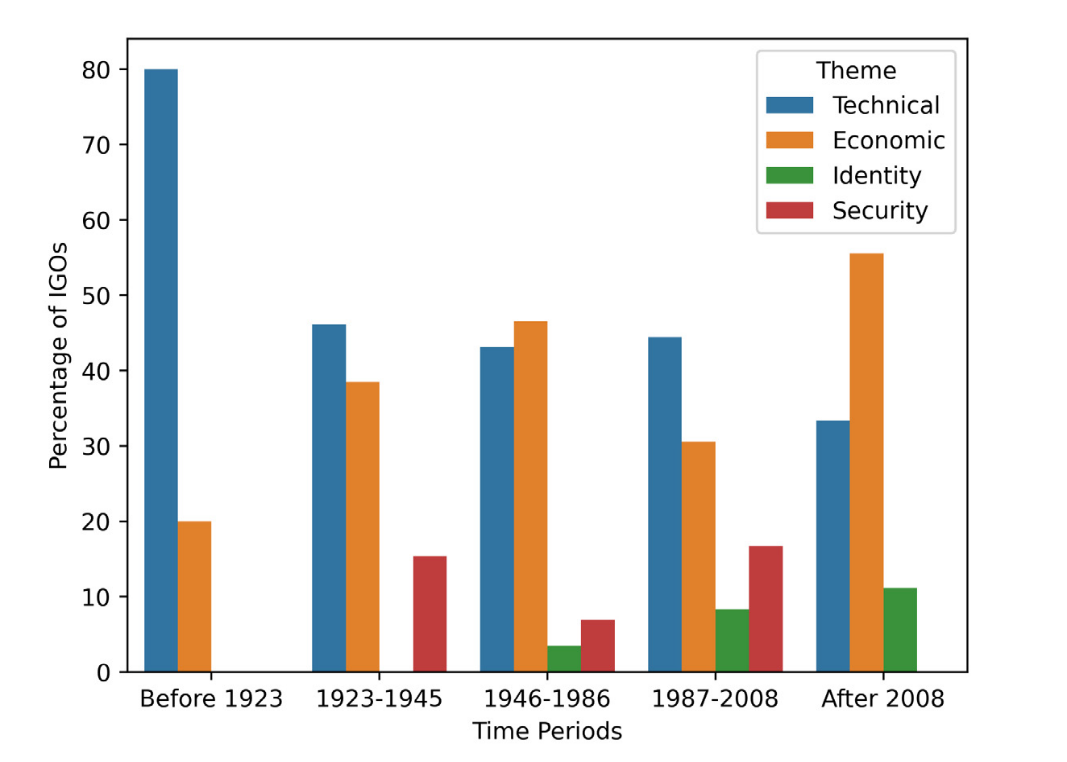
In addition to the founder status of the IGOs it has joined, the functional themes of the IGOs in Türkiye’s portfolio have evolved, hinting at diversification efforts along with changing foreign policy priorities. Overall, economic and technical cooperation IGOs dominate Türkiye’s memberships in sheer number, which is consistent with many countries’ participation in development and technical agencies. However, as can be seen in Figure 2, a noteworthy trend is the rise of identity-based organizations in Türkiye’s engagement, particularly in the late Cold War and post-Cold War periods. After the 1980s, Ankara increasingly joined or founded IGOs defined by cultural or religious identity (Turkic, Islamic, or regional identity). In fact, from 1987 to 2008, every identity-themed IGO that Türkiye joined was one that it had played an initiator role in, indicating the country was not merely participating in these platforms but actively seeking to create them (Ataman et al. 99). Meanwhile, security-oriented IGOs remain a smaller share of the portfolio, suggesting either a pivot away from traditional security alliances toward other forms of cooperation or global saturation with the existing security arrangements.
Figure 2. Distribution of IGOs with Türkiye’s membership by their major theme and selected time periods.
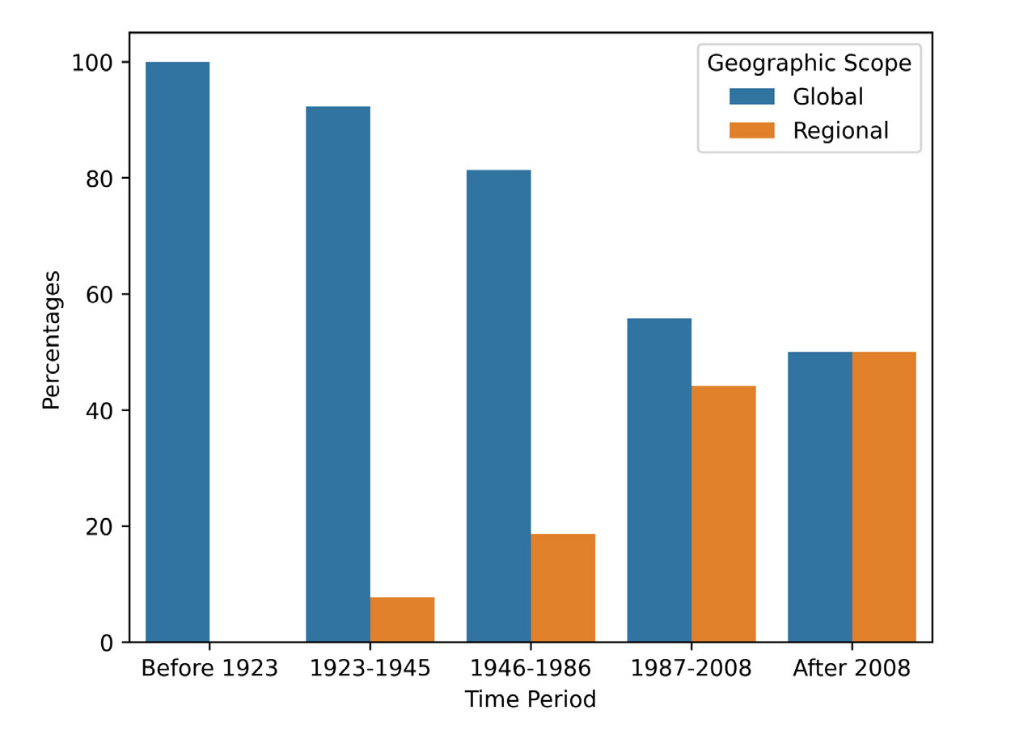
Most importantly, Türkiye’s orientation within IGOs has gradually shifted from a predominantly global focus toward a more regional one. Earlier in the republic’s history, most of Türkiye’s IGO memberships were in global organizations that are mostly Western-led institutions (Ataman et al. 97-98). While global IGOs still play a major role, the share of regional IGOs in Türkiye’s new memberships has consistently grown in each period, and by the post-2008 era, new regional ties had caught up to new global ties. As can be seen in Figure 3, after 2008, new memberships in regional organizations accounted for an equal portion of Türkiye’s IGO engagements compared to global ones. These trends comply with the interpretation that Türkiye’s new foreign policy manifests strongly in region-centric and identity-centric organizations.
Türkiye has increasingly initiated and participated in regional IGOs that align with its cultural and strategic sphere. Notable examples include the BSEC in 1992, the Developing Eight (D-8) group of Muslim-majority emerging economies in 1997, and cultural-identity unions like TÜRKSOY. In the 2000s, this trend continued with efforts like the OTS, established in 2009 with Türkiye as a driving force. These organizations often emphasize shared identity - whether Islamic solidarity, Turkic ethnic/cultural ties, or regional neighborhood bonds - reflecting features of Türkiye’s “new foreign policy” (Purtaş, “Türkiye and”). Our data shows Türkiye is even more likely to be an initiator for organizations that have a strong identity component linked to Turkicness or the Muslim world. In short, Ankara’s proactive involvement in such IGOs underscores how its foreign policy has pivoted to regionalism and identity-based multilateralism, as it seeks to build its own coalitions and spheres of cooperation rather than simply joining Western institutions.
Figure 3. Percentages of Türkiye’s new relations with IGOs by geographic scope in selected time periods.
Such a pivot to this novel regionalism is not only about identity, but primarily a response to structural constraints that have emerged in the last decade in global politics as well as deteriorating security conditions in its surrounding regions. For many states, in today’s multipolar world, reliance on a single alliance system is a strategic liability. Türkiye’s historical dependence on the Euro-Atlantic security umbrella has become increasingly problematic since 2014 as interests diverged on key issues ranging from the presence of the PKK/YPG terrorist group in Syria to the Eastern Mediterranean and sanctions on the local defense industry. However, Türkiye has not been a part of the anti-Western axis either. “Strategic Regionalism,” in this deadlock, serves as a hedging strategy (Wicaksana and Karim). By institutionalizing its relations with the Turkic world, Ankara creates a third vector of cooperation independent of both the West (NATO/EU) and the East (Russia/China).
This diversification is not a complete rupture with Türkiye’s existing commitments but rather a negotiation strategy and a risk-averse choice. Türkiye’s activism in the Middle East, Africa, and Central Asia is designed to increase its value as a partner while reducing its vulnerability to coercion (Özkan and Akgün). Türkiye’s new strategic regionalism approach provides it with strategic depth. It allows Ankara to project power into the heart of Eurasia, balancing Russian influence in its “near abroad” without directly confronting Moscow. By offering Central Asian states an alternative window to the world, Türkiye creates an interdependent network where it serves as the central node, thereby enhancing its global status.
Economic Integration and Growth
The economy constitutes the most concrete and pragmatic aspect of Türkiye’s regionalist motivation. Maintaining its identity as a trading state, Türkiye views the prominent regional IGOs as platforms of opportunity for market expansion and enlarging the investment basin. Central Asia and the Caucasus, with their rich energy resources and untapped markets, offer a critical hinterland for Turkish exports.
However, the motivation here is not just to sell goods, but to establish an economic ecosystem that creates interdependence. Simplifying customs procedures, establishing the Turkish Investment Fund, and diversifying energy transmission lines aim to integrate the prosperity of the region’s countries with the Turkish economy. While Türkiye aims to become an energy hub for transporting the region’s energy resources (Caspian gas) to Europe (Ağır and Aksu), it also opens new windows of opportunity in the Asian steppes for Turkish construction and manufacturing sectors. Through providing such structural inputs, Türkiye actively supports the economic diversification of other member states by facilitating their transition from resource-dependent economies to multi-sectoral markets, which, in turn, creates a mutually beneficial interdependent economic architecture (Baghirov). This economic symbiosis is the fundamental pillar that increases the resilience of political relations against systemic fluctuations. The contribution of Türkiye to regional resilience is particularly stressed by the high-level officials of the OTS, as can be observed in one of the interviews conducted in this study:
We face certain structural problems across our member states. One of the most crucial of these is achieving successful economic diversification. In this regard, the development of small and medium-sized enterprises (SMEs) is particularly important. In some member states, such as Kazakhstan and others in Asia, a limited number of sectors dominate the economy, which makes diversification essential. By contrast, SMEs play a highly influential role in Türkiye’s economy. If I am not mistaken, nearly 80 percent of Türkiye’s GDP is generated by small and medium-sized enterprises. Moreover, Türkiye has pursued an export-led growth strategy for many years. For these reasons, Türkiye has a particular comparative advantage in supporting economic diversification among member states. It can contribute significantly through capacity-building programs, sharing institutional experience, and familiarizing member states with its legal and regulatory frameworks. (Kocaman)
Defense Cooperation and Security Autonomy
The most significant deviation from the established understanding of the NRA of the 1990s is the integration of hard power components into the regionalist mindset of Türkiye. Turkish foreign policy has reintroduced the security pillar of regionalism into the NRA through novel mechanisms and logic. Instead of forming old-style rigid military alliances like the Collective Security Treaty Organization, which implies limiting the autonomy of junior partners to patron states, Türkiye pursues defense cooperation based on mutual capacity building and interoperability (Yeşiltaş). Hence, we contend that the logic of capacity building in Turkish regionalism is not limited to the economic sphere; it naturally extends to the security sphere as well.
In today’s fragmented world, where global powers disregard all norms, principles, or rules, all states, especially small and middle powers, are concerned about their survival. With the return of power politics to international politics, no state is immune to intensifying global rivalry and interference from other states. Therefore, small states and middle powers want to diversify their supply sources in the defense industry and purchase weapons with no conditionality. In this context, Türkiye is one of the best alternatives from which the Turkic states can purchase tested high-tech weapons and ammunition to maximize their national interests and increase their strategic autonomy.
The demand from the OTS member states for Turkish military expertise provides a practical basis for a major theoretical shift in Ankara’s approach, which is also emphasized by one of the senior diplomats of the OTS in our interviews: “Another important area is defense cooperation. Given Türkiye’s critical geopolitical location, it has developed significant capabilities and capacity in the defense industry. Türkiye is therefore ready, and eager, to contribute further by sharing its experience and expertise in defense and defense industry cooperation with member states” (Kocaman).
The export of Turkish defense technology, particularly TB2 unmanned aerial vehicles (UAVs), to several Central Asian states is a strategic tool. These exports, labeled as capacity building, create a security-technology ecosystem dependent on Turkish technology, doctrine, and training. This fosters a form of integration that is functional and sticky; partner states become enmeshed in a Turkish logistics and intelligence network. This allows Türkiye to act as a “security provider,” cementing its status as the indispensable power in the region without the political baggage of stationing permanent garrisons or demanding political subservience. Thus, the Central Asian states are spared from being caught in the middle of great power rivalries.
Support Base for the Global Agenda
Türkiye has increasingly positioned itself as a voice for the Global South and a critic of the current international order, a stance encapsulated in President Erdoğan’s slogan, “The World Is Bigger Than Five.” However, challenging the structure of the UN Security Council requires more than rhetoric; it requires votes and a coalition. Our research indicates that Türkiye views the OTS as a critical “support base for global agendas.” In this context, regional organizations serve as force multipliers in multilateral diplomacy. By harmonizing the foreign policy positions of Azerbaijan, Kazakhstan, Uzbekistan, and Kyrgyzstan, Türkiye aims to transform the OTS into a unified voting bloc within the UN and other international fora. This is “Strategic Regionalism” in practice: Converting regional cultural affinity into a quantifiable diplomatic asset on the global stage. The goal is to socialize partner states to promote a shared perspective on global governance, thereby reinforcing Türkiye’s role as an influential actor extending beyond the boundaries of the nation-state to a broader civilizational context.
It is noteworthy that Türkiye’s efforts to connect partner states within the international platform cannot be attributed solely to the AK Party era and its relationships within the OTS. Particularly, Türkiye has mobilized diplomatic resources to promote connections of newly independent Turkic states with the global society, including the European Union, NATO, and the UN. Türkiye has actively engaged with prevailing institutions to encourage improving relations with the Turkic world and envisaged a well-connected Turkic world in the international society. This point was particularly stressed by one of the experts in our interviews:
Considering Türkiye’s efforts to promote cooperation with various international organizations, one notable example is NATO’s Partnership for Peace program in the early 1990s, which Türkiye utilized more actively than any other country. Through Türkiye’s initiatives, these states were able to establish institutional ties with NATO. Overall, Türkiye has made substantial contributions to the inclusion of these countries in the international system and to their attainment of a recognized and respected international standing. (Purtaş, Personal Interview)
Our analysis indicates that the trend in Türkiye’s efforts to improve the connectivity of the partner states did not change during the AK Party period, though Ankara’s focus significantly regionalized. Türkiye embarked on concerted policies to increase connectivity within its proximate region, aimed at establishing novel connections between the Turkic world and other non-Western international actors in the Middle East, Caucasus, Asia, and Africa. One facet of these diplomatic efforts manifests itself in the context of Islamic cooperation, where Türkiye plays a role in mediating relations between the nations. To illustrate, Türkiye has vehemently supported Azerbaijan’s membership in the D-8, though its bid for membership may not be easily accepted due to its relatively small population and economic capacity, considering the D-8 primarily includes Muslim-majority countries with larger populations and gross domestic products (Purtaş, Personal Interview). Recently, Türkiye’s efforts to enhance diplomatic relations of the Turkic world accelerated with its proposal of “OTS Plus,” which envisages increasing the visibility and connectivity of the Turkic world (Musabay Baki; Mustofaev). As explained by a senior diplomat within the OTS:
The OTS Plus proposal was initiated by Türkiye with the aim of increasing the visibility and relevance of the organization through cooperation with third parties and external actors. These partners may include international organizations or states such as ASEAN, the African Union, South Korea, Japan, Mongolia, or Georgia. Naturally, the proposal will be discussed and implemented on the basis of consensus among the member states. Through the OTS Plus framework, the organization plans to develop cooperation with selected states and international organizations in the future in order to generate concrete benefits. This cooperation will focus on specific sectors and policy areas and is expected to produce tangible outcomes that benefit both the member states and the external partners involved in OTS Plus activities. (Kocaman)
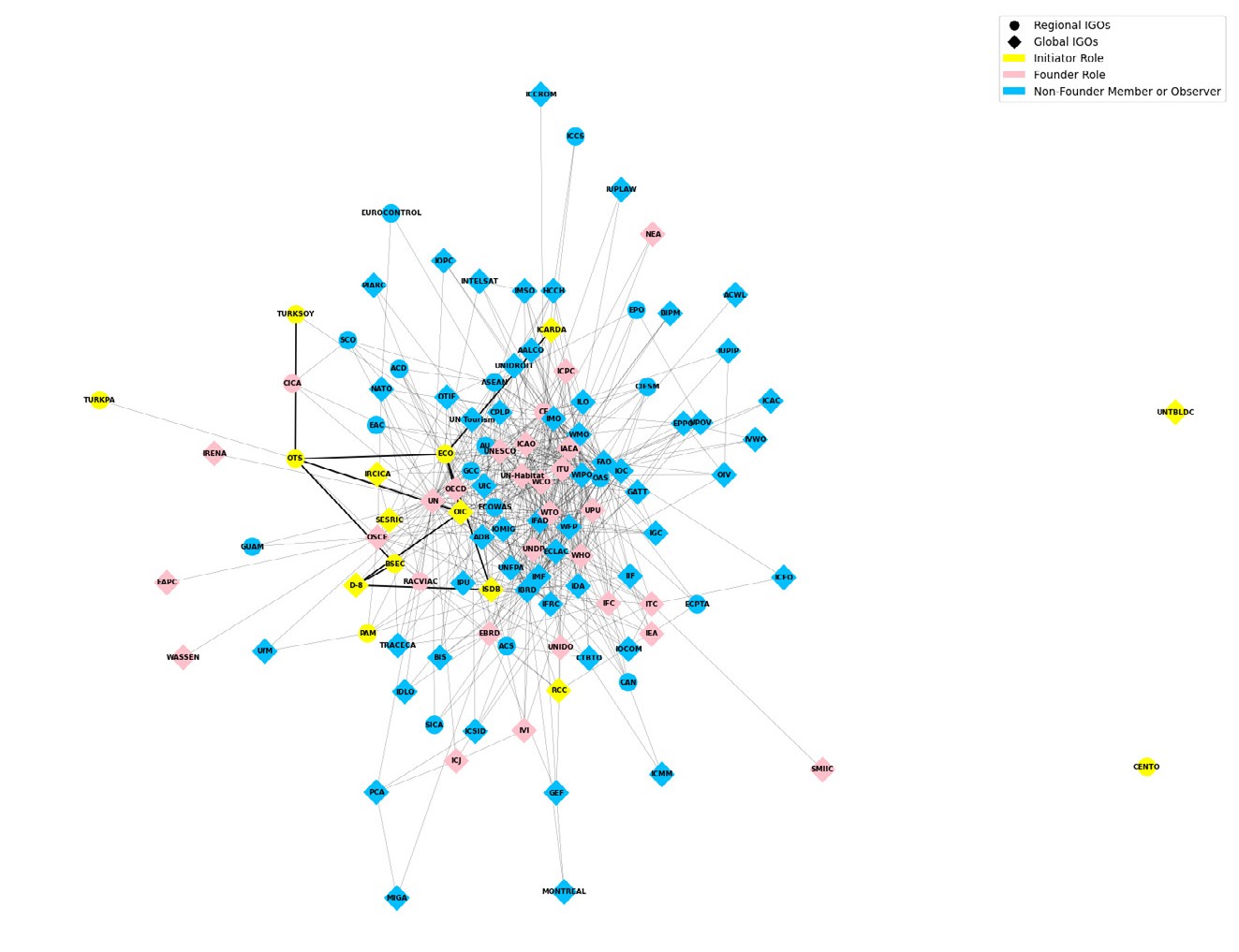
This connectivity between regions not only relies on anecdotal instances but can also be indicated with empirical evidence. Using network analysis, the study mapped out a network of formal links between IGOs, such as alliances, cooperation agreements, or institutional partnerships among the organizations. In the network graph seen in Figure 4, each node (colored circles) represents an IGO, and the lines (links between the nodes) indicate formal relationships between two IGOs. The structure reveals a densely connected core of influential IGOs at the center. These highly connected nodes are largely global, well-established organizations with broad membership, such as the UN and its agencies, the World Trade Organization (WTO), the International Monetary Fund (IMF), the World Health Organization (WHO), and the World Bank, all cluster centrally due to many inter-organizational ties. The network visualization distinguished IGOs by Türkiye’s role in them: yellow nodes for IGOs that Türkiye helped initiate, pink nodes for IGOs where Türkiye is a founding member (but not an initiator nation), and blue nodes for IGOs where Türkiye is simply a non-founder member.
One clear pattern that emerges from this visualization is that the IGOs that Türkiye initiated are mostly on the periphery of the network graph. In general, Türkiye-initiated organizations, which are mostly newer, regional, or identity-themed organizations, have far fewer inter-IGO linkages compared to the well-established global institutions. They tend to be more self-contained or connected within a smaller circle. This peripheral placement correlates with lower centrality measures for those IGOs. These organizations have lower closeness centrality, which means that they are not centrally located in terms of distance to all other nodes, and lower betweenness centrality, which means that they are not frequently on the shortest communication paths between other IGOs. In practical terms, the organizations in which Türkiye plays an initiator role are not yet highly integrated into the broader web of global governance; they often operate in niche areas or regions, albeit some exceptions to this pattern exist.
Figure 4. A network graph of bilateral legal relations between IGOs with the membership of Türkiye (Source: Union of International Associations (UIA), Graph is the authors’ own production).
Despite the mostly peripheral orientation of the organizations in which Türkiye plays a greater role, these analyses ask whether these Türkiye-initiated organizations constitute their own community and are densely connected within this community. In order to answer this question, our analysis also zoomed in on the sub-network consisting only of IGOs that Türkiye helped initiate. Within this subnetwork, one can see that these organizations cluster together to some degree, indicating Türkiye’s efforts may be creating a parallel mini-network of its own initiatives. For example, the OTS maintains formal relationships with several culturally or regionally related IGOs. It is linked to TÜRKSOY, TÜRKPA, as well as to economic or regional groups like the BSEC and the ECO, and even has ties to the broader Islamic world via the OIC. These connections, depicted by lines, with some especially important ties highlighted in the network graph, show that Türkiye’s initiated organizations cooperate, forming a discernible web of regional cooperation.
Operationalizing Strategic Regionalism: A Hybrid and Egalitarian Architecture
The OTS has drawn a growing body of scholarship in recent years, and it is worth setting out how our reading relates to it. Existing studies have come at the organization from different directions. Some concentrate on its economic potential, tracing cooperation in trade, transport, and energy among the member states (Baghirov; Ağır and Aksu). Others approach it through a security lens and ask whether the Turkic states are moving toward a pluralistic security community (Sarı). A third group foregrounds culture and identity, treating shared language and history, and bodies such as TÜRKSOY, as the connective tissue of Turkic cooperation (Akıllı). Still others locate the organization in the politics of the post-Soviet space, where the “Turkic world” idea took hold among Turkish elites in the 1990s and where the sovereignty concerns of the newly independent republics continue to shape what is possible (Köstem; Dosbolov and Sönmez). Between them, these works have documented the economic, cultural, and institutional sides of the OTS in real detail.
The organization's institutional path helps explain why it lends itself to this reading. It began as the Cooperation Council of Turkic-Speaking States, set up by the 2009 Nakhchivan Agreement, which gave the long-standing idea of Turkic cooperation its first permanent home (Kahveci and Kuşçu Bonnenfant). Over the next decade a cluster of connected bodies grew up around it—TÜRKSOY in culture, TÜRKPA at the parliamentary level, and the Turkic Academy in education and research—each extending cooperation into a different field. Momentum picked up after 2021, when the eighth summit in Istanbul renamed the body the Organization of Turkic States and endorsed the “Turkic World Vision 2040,” which set out longer-term political, economic, and security goals (Mustofaev). Two developments gave this framework more weight. The Turkic Investment Fund, agreed in 2022 and in force by 2024, added a financial mechanism to what had been a mainly political and cultural structure. And connectivity projects, above all the Middle Corridor across the Caspian, turned the shared rhetoric of unity into physical infrastructure, offering the landlocked republics a trade route that does not run through Russia. Taken together, this shift from a loose consultative forum into a layered organization with its own funding and connectivity instruments is what makes the OTS a useful case for watching how Türkiye builds and anchors regional institutions.
To realize its strategic motivations, Türkiye employs a cohesive strategy that seamlessly integrates a hybrid toolkit with a distinct diplomatic modus operandi. This approach creates a symbiotic relationship where cognitive and functional tools provide the structural basis for integration, while an egalitarian behavioral model ensures its political sustainability.
On the cognitive front, Türkiye is engineering a shared consciousness through institutions such as TÜRKSOY, the Turkic Academy, and the Turkic Culture and Heritage Foundation. Far from being marginal cultural bodies, these institutions are central to the strategic regionalism approach. By promoting a common history curriculum, working toward a unified alphabet, and synchronizing media narratives, Ankara fosters a “cognitive region” where political cohesion feels natural rather than forced. Unlike the “Old Regionalism,” which relied on perceptions of external threats, this approach capitalizes on “internal cohesion” derived from a shared heritage.
Complementing this cognitive framework is the “functional connectivity” that provides material mechanisms for integration. Türkiye has prioritized physical infrastructure to bind the region together, most notably through the Middle Corridor (the Trans-Caspian International Transport Route). As a strategic response to the vulnerability of global supply chains, the Middle Corridor connects China to Europe via Central Asia, the Caspian Sea, the Caucasus, and Türkiye, bypassing the Russian-dominated Northern Corridor. For the landlocked Central Asian republics, this offers a lifeline of sovereignty; for Türkiye, it realizes the ambition of becoming a pivotal energy and logistics hub. This functional integration, further institutionalized by the establishment of the Turkic Investment Fund, aligns with the logic of “New Regionalism” (Ethier) by creating an engine of prosperity that cements Türkiye’s role not just as a cultural cousin but as an indispensable economic partner.
However, the possession of hybrid tools is insufficient to explain the deepening of the cooperation; the success of strategic regionalism is equally contingent on how these tools are wielded. The most critical finding of this study, supported by network analysis and interviews, is that Türkiye’s behavior within the OTS is fundamentally different from the hegemonic models of rival powers. In a post-Soviet geopolitical environment defined by a fierce defense of independence, Türkiye deliberately eschews the role of a “hegemon,” or “big brother.” Instead, contrasting with the supranational conditionality of the EU or the structural dominance found in the Eurasian Economic Union (EAEU), Türkiye adopts the posture of a “facilitator” and “initiator.”
This commitment to sovereign equality is not merely rhetorical but is embedded in the organization’s institutional design. As emphasized in interviews with high-level bureaucrats, Türkiye does not claim an exclusive role in agenda-setting. One high-level diplomat articulated this principle clearly:
As I mentioned earlier, Türkiye does not have a special or exclusive role in agenda setting. Sovereign equality is a fundamental principle for us, and all member states have an equal say in determining the organization’s agenda. ... Agendas are always shaped by member states in cooperation with the secretariat, based on their respective needs and priorities. ... Therefore, it would not be accurate to claim that any particular country is more influential than others in setting the agenda or introducing agenda items. (Kocaman)
To ensure this egalitarianism, the OTS operates strictly on consensus, granting even the smallest member state veto power. Furthermore, Türkiye actively encourages a participatory culture: The secretariat staff is composed of bureaucrats from different member states to avoid Turkish dominance, and diplomatic summits rotate among capitals (e.g., Samarkand, Bishkek, Shusha) to ensure collective ownership. Network analysis confirms this “dense” topology, where Türkiye encourages horizontal interactions between other members rather than monopolizing ties. This approach has successfully reassured partners, as noted by a senior diplomat:
They have a positive perception and a clear understanding of Türkiye’s role. ... They are aware that all members are sovereign and equal. ... Having only recently gained their independence after long periods under dominant external powers, these countries are particularly attentive to being treated as equal partners. Türkiye recognizes this and conducts its relations accordingly. (Mukazhan)
Theoretically, this behavior represents a form of “strategic restraint.” By voluntarily limiting its own power and refusing to dictate terms, Türkiye makes its initiative acceptable to states wary of external influence. By acting as a peer and coordinator rather than a master, Türkiye ensures the sustainability of the cooperation, proving that members support the organization not because they are forced to, but because it strengthens their own sovereignty.
This emphasis on restraint does not mean that asymmetry is absent. Türkiye avoids formal hierarchy and supports the principle of sovereign equality, yet differences in capacity remain between Ankara and its partners in areas such as diplomatic resources, defense industry, economic weight, and institutional initiative. The location of the secretariat in Istanbul and Türkiye's frequent role in proposing new institutional steps, including initiatives such as “OTS Plus” reflect this position. Acknowledging these differences does not weaken our argument. It makes it more precise.
The evidence does not suggest that Türkiye lacks a leading role. It suggests that Türkiye exercises this role in a restrained and consensual manner. Instead of turning its greater capacity into hierarchy or conditionality, Ankara works mainly through consensus and horizontal cooperation. This approach fits the character of an organization whose members place strong value on sovereignty and equal standing, and it also serves Türkiye's own long-term interest in keeping the partnership durable and voluntary (Dosbolov and Sönmez; Sarı). Seen from a constructivist perspective, the OTS operates less as an instrument of dominance and more as a platform for shared norms, in which Türkiye acts as an initiator of cooperation rather than as a hegemon (Yesevi). The “facilitator” role can therefore be read as a source of legitimacy: a form of self-restraint that helps convert Türkiye's weight into more stable and widely accepted influence (Oğuzlu).
Conclusion
In the last two decades, during which the international system has evolved from a unipolar Western hegemony to a multipolar and ambiguous structure, the most significant change in Türkiye’s foreign policy trends is its increasing interest in and activism toward regional international organizations. However, the existing literature suffers from an analytical deficiency in explaining Ankara’s new institutional orientation. Dominant views tend to label this situation either as a revisionist axis shift symbolizing a break from the West or simply as an emotional pursuit of several grand “isms” driven by historical or cultural impulses. This study rejects these reductionist approaches and centers on a more structural question: What strategic considerations drive Türkiye’s expanding involvement in regional international organizations, and how do these considerations shape its diplomatic practices within them? Therefore, the main aim of our research is not merely to examine a single organization, but to analyze the logic of action behind Türkiye’s use of regional organizations as a foreign policy instrument.
This study is one of the novel contributions to the literature as a new take on Strategic Regionalism, a concept we modified and expanded to make sense of Türkiye’s actions in the OTS. While earlier works usually focus on economics and material interests, we push the conversation forward by reworking this framework to fit Türkiye’s unique situation. Our model does not see strategic regionalization as just countries pooling mainly economic interests and identity proximity. Instead, we argue it is a hybrid foreign policy tool. Here’s what that means: The cognitive factors, such as shared identity, language, and history, work together with functional aspects like trade, energy, and infrastructure as highlighted by the New Regionalization Approach. Both sides reinforce each other to help Türkiye reach two big goals: strategic autonomy and security. Türkiye aims to strengthen its own sovereignty and autonomy through regional cooperation, not diluting it. In this framework, Türkiye's strategic regionalism is considered a new form of regionalism, in which soft power is employed to establish institutional and political conditions that increase the state's strategic influence. Within this model, shared identity is operationalized as a facilitator to lower transaction costs, while economic cooperation mechanisms serve as structural binders, ultimately consolidating a non-hierarchical yet geo-strategically autonomous power center.
In this study, we found that Türkiye’s relations with regional international organizations may reflect a gradual adaptation to a fragmenting international order. Our data indicates that Türkiye is making a concerted effort to incorporate regional international organizations into its foreign policy. The political salience of the regional international organizations has been particularly emphasized in the AK Party era, where the role of regional international organizations transcends being mere platforms of high-level diplomatic engagements. Rather, regional international organizations carry more weight in the blueprints of Türkiye’s regional foreign policy framework. Through the lens of Strategic Regionalism, we find that Ankara now utilizes the multidimensional tools of New Regionalism, such as identity-based cognitive construction and functional economic connectivity, to pursue regional and global foreign policy objectives, including strategic autonomy, foreign policy diversification, and defense industry expansion.
Crucially, our elite interviews confirm that the sustainability of this model rests on a distinct behavioral shift in Türkiye’s relations with international organizations: The rejection of hegemonic or hierarchical leadership in favor of a facilitator role rooted in sovereign equality and consensus. By exercising strategic restraint and prioritizing horizontal interactions, Türkiye has positioned itself as a non-threatening center of attraction. Ultimately, the OTS serves as a primary validation of how middle powers can generate autonomous geopolitical gravity, offering a template for regional cooperation that preserves state sovereignty in an increasingly uncertain global landscape.
The norm-based international system has changed drastically over the last two decades. Small and middle powers have begun to revise their foreign policies against changing regional and global dynamics, including accelerated global rivalries and increased uncertainties. The collapse of the universal international institutions and erosion of universal values force all states to take necessary measures against these challenges. One of the most effective measures is the establishment of regional platforms to increase their deterrence and resilience. Due to their unilateral policies, small and middle powers hardly trust global powers anymore. In light of all these developments, regionalization initiatives with their various forms and versions appear likely to continue serving as a haven not only for Türkiye but also for many countries with similar status and positions.
Acknowledgment
This article is based on Project No. SBF-2025-236, which was conducted and completed with the support of the Scientific Research Projects Coordination (BAP) Unit at the Social Sciences University of Ankara (ASBÜ). We would like to take this opportunity to thank the entire dedicated team at the ASBÜ BAP Unit.
Author Contributions
Dr. Öğr. Üyesi Metin Yücekaya (25%): Idea/Conceptualization, Theoretical Background, Methodology, Data Analysis.
Prof. Dr. Muhittin Ataman (25%): Idea/Conceptualization, Theoretical Background, Data Analysis.
Dr. Öğr. Üyesi Ömer Naim Küçük (25%): Methodology, Data Collection, Data Analysis, Preparation of Tables and Figures.
Mehmet Adanmış (25%): Data Collection.
Conflict of Interest Statement
There is no conflict of interest with any institution or person within the scope of this study. There is no conflict of interest between the authors.
Ethics Statement
Ethics approval for this study was obtained from the Social and Human Sciences Research and Scientific Publication Ethics Committee of Ankara Social Sciences University Rectorate (Document Date: August 19, 2024; Decision No. 127999).
Görsel, Şekil ve Tablolar
Kaynakça
- Ağır, Osman, and Zehra Aksu. “Efforts for Energy-Based Regionalisation in the Turkic World: The Organization of Turkic States.” bilig, no. 109, 2024, pp. 105-128.
- Akıllı, Erman. “TURKSOY, Turkic Council and Cultural Diplomacy: Transactionalism Revisited.” bilig, no. 91, 2019, pp. 1-25.
- Altunışık, Meliha Benli. “The Trajectory of a Modified Middle Power: An Attempt to Make Sense of Turkey's Foreign Policy in Its Centennial.” Turkish Studies, vol. 24, nos. 3-4, 2023, pp. 658-672.
- Aras, Bülent. “The Davutoğlu Era in Turkish Foreign Policy.” Insight Turkey, vol. 11, no. 3, 2009, pp. 127-142.
- Ataman, Muhittin, et al. “Türkiye’s Increased Activism in International Organizations as an Initiator State.” Insight Turkey, vol. 27, no. 1, 2025, pp. 87-112.
- Baghirov, Orkhan. “The Organization of Turkic States' Economic Potential and Cooperation Prospects among Its Members.” Perceptions: Journal of International Affairs, vol. 27, no. 1, 2022, pp. 53-73.
- Dal, Emel Parlar, and Ali Murat Kurşun. “Assessing Turkey's Middle Power Foreign Policy in MIKTA: Goals, Means, and Impact.” International Journal, vol. 71, no. 4, 2016, pp. 608-629.
- Dosbolov, Abzal, and Göktuğ Sönmez. “The Organization of Turkic States and Postcolonialism in Central Asia: Possible Contributions, Prospects, and Limitations.” Insight Turkey, vol. 25, no. 4, 2023, pp. 91-133.
- Erşen, Emre. “The Return of Eurasianism in Turkey: Relations with Russia and Beyond.” Turkey's Pivot to Eurasia: Geopolitics and Foreign Policy in a Changing World Order, eds. Emre Erşen, and Seçkin Köstem, Routledge, 2019, pp. 31-47.
- Ethier, Wilfred John. “The New Regionalism.” The Economic Journal, vol. 108, no. 449, 1998, pp. 1149-61.
- Gilson, Julie. “Strategic Regionalism in East Asia.” Review of International Studies, vol. 33, no. 1, 2007, pp. 145-63.
- Hettne, Björn. “Developmental Regionalism.” New Directions in Development Economics: Growth, Environmental Concerns and Government in the 1990s, ed. Mats Lundahl, and Benno J. Ndulu, Routledge, 1996, pp. 142-157.
- Hettne, Björn, and Fredrik Söderbaum. “The New Regionalism Approach.” Politeia, vol. 17, no. 3, 1998, pp. 6-21.
- Hettne, Björn, and Fredrik Söderbaum. “Theorising the Rise of Regionness.” New Political Economy, vol. 5, no. 3, 2000, pp. 457–72.
- Kahveci, Hayriye, and Işık Kuşçu Bonnenfant. “Turkish Foreign Policy towards Central Asia: An Unfolding of Regionalism and Soft Power.” All Azimuth: A Journal of Foreign Policy and Peace, vol. 12, no. 2, 2023, pp. 195-218.
- Kardaş, Şaban. “Charting the New Turkish Foreign Policy.” International Journal, vol. 67, no. 1, 2011, pp. 1-6.
- Kirişci, Kemal. “The Transformation of Turkish Foreign Policy: The Rise of the Trading State.” New Perspectives on Turkey, no. 40, 2009, pp. 29-57.
- Kocaman, Ömer. Personal Interview with Deputy Secretary General of the Organization of Turkic States. 19 Dec. 2025.
- Koçak, Muhammet, and Musa Akgül. “Quest for Regional Power Status: Explaining Turkey’s Assertive Foreign Policy.” International Journal, vol. 77, no. 2, 2022, pp. 292-312.
- Köstem, Seçkin. “When Can Idea Entrepreneurs Influence Foreign Policy? Explaining the Rise of the ‘Turkic World’ in Turkish Foreign Policy.” Foreign Policy Analysis, vol. 13, no. 3, 2017, pp. 722-740.
- Kutlay, Mustafa, and Ziya Öniş. “Understanding Oscillations in Turkish Foreign Policy: Pathways to Unusual Middle Power Activism.” Third World Quarterly, vol. 42, no. 12, 2021, pp. 3051-3069.
- Luke, Douglas Alan. “Introducing Network Analysis in R.” A User’s Guide to Network Analysis in R, Springer, 2015, pp. 1-8.
- Morales-Fajardo, María Esther. “Strategic Regionalism of the Pacific Alliance: An Outlook throughout the Investment.” Journal of Globalization Studies, vol. 15, no. 1, 2024, pp. 18-35.
- Musabay Baki, Pelin. "Turkic World Vision–2040: A Step Forward for the Resilience of Turkic Cooperation." Perceptions: Journal of International Affairs, vol. 27, no. 1, 2022, pp. 26–52.
- Mustofaev, Murodjon. “The Organization of Turkic States: A New Approach to Global and Regional Challenges.” Perceptions: Journal of International Affairs, vol. 27, no. 1, 2022, pp. 105-120.
- Mukazhan, Merey. Personal Interview with Deputy Secretary General of the Organization of Turkic States. 20 Dec 2025.
- Oğuzlu, Tarık. “Turkey as a Restrained Middle Power.” Turkish Studies, vol. 24, nos. 3-4, 2023, pp. 673-690.
- Öniş, Ziya, and Şuhnaz Yılmaz. “Between Europeanization and Euro-Asianism: Foreign Policy Activism in Turkey during the AKP Era.” Turkish Studies, vol. 10, no. 1, 2009, pp. 7-24.
- Özkan, Mehmet, and Birol Akgün. “Turkey’s Opening to Africa.” The Journal of Modern African Studies, vol. 48, no. 4, 2010, pp. 525-46.
- Purtaş, Fırat. “Türkiye and the Organization of Turkic States: A Strategic Partnership for Regional Integration.” Insight Turkey, vol. 27, no. 1, 2025, pp. 113-32.
- Purtaş, Fırat. Personal interview with Former Deputy Secretary General of TURKSOY. 30 Dec. 2025.
- Republic of Türkiye Ministry of Foreign Affairs. “International Organisations.” Republic of Türkiye Ministry of Foreign Affairs, https://www.mfa.gov.tr/sub.en.mfa?7cafe2ef-78bd-4d88-b326-3916451364f3.
- Sarı, Buğra. “Security Aspect of the Integration in Turkic World under the Organization of Turkic States.” Insight Turkey, vol. 25, no. 4, 2023, pp. 139-161.
- Scott, James Wesley. “Transboundary Co-operation on Germany’s Borders: Strategic Regionalism through Multilevel Governance.” Journal of Borderlands Studies, vol. 15, no. 1, 2000, pp. 143-167.
- Türbedar, Erhan. “Turkey's New Activism in the Western Balkans: Ambitions and Obstacles.” Insight Turkey, vol. 13, no. 3, 2011, pp. 139-158.
- Tüysüzoğlu, Göktürk. “The Eurasianist Transformation of Turkish Foreign Policy after the Coup Attempt: An Evaluation in the Context of the SCO.” Asian Journal of Middle Eastern and Islamic Studies, vol. 17, no. 1, 2023, pp. 83-105.
- Uzer, Umut. “The Revival of Ottomanism in Turkish Foreign Policy: ‘The World Is Greater Than Five.’” Turkish Policy Quarterly, vol. 16, no. 4, 2018, pp. 29-36.
- Väyrynen, Raimo. “Regionalism: Old and New.” International Studies Review, vol. 5, no. 1, 2003, pp. 25-51.
- Wicaksana, I Gede Wahyu, and Moch Faisal Karim. “How Regional Organisation Survives: ASEAN, Hedging and International Society.” Contemporary Politics, vol. 29, no. 5, 2023, pp. 659-679.
- Yearbook of International Organizations. Union of International Associations, https://uia.org/ybio/.
- Yesevi, Çağla Gül. “Examining the Organization of Turkic States: A Teacher and Norm-Creator.” Perceptions: Journal of International Affairs, vol. 27, no. 1, 2022, pp. 2-25.
- Yeşiltaş, Murat. “Deciphering Turkey’s Assertive Military and Defense Strategy: Objectives, Pillars, and Implications.” Insight Turkey, vol. 22, no. 3, 2020, pp. 89-114.