


Abstract
The period of Kublai Khan is known as when innovative economic practices were adopted in China, and the use of paper money was turned into a state policy. While previous dynasties ruling the Chinese lands had limited paper money to regional contexts, Kublai Khan made it compulsory across the country and turned paper money into a centralised means of payment. By establishing exchange offices, he also prohibited the outflow of metal coins from the government and ensured that the precious metals remained within the borders. Through this policy, he could keep the money supply under control and reinforce the legitimacy of the central authority. Widely used in tax collection, gift giving, and salaries, paper money became one of the essential elements of the dynasty’s financial system. Interactions, developments and transformations related to paper money are evident in Chinese and Uyghur written sources and this study examines the subject within this framework.
Öz
Kubilay Kağan Dönemi Kâğıt Paranın Meşruiyeti ve Kullanımı
Kubilay Kağan dönemi Çin coğrafyasında iktisadi alanda yenilikçi uygulamaların benimsendiği kâğıt paranın devlet politikası hâline geldiği bir süreç olarak bilinmektedir. Çin coğrafyasında hüküm süren hanedanlar kâğıt para kullanımını bölgesel çerçevede sınırlarken Kubilay Kağan ise ülkenin genelinde kullanımını zorunlu hâle getirerek kâğıt parayı merkezî bir ödeme aracı hâline dönüştürmüştür. Para değişim merkezleri kurmak suretiyle de madenî paraların ülke dışına çıkışını yasaklamış madenî zenginliklerin sınırlar içerisinde kalmasını sağlamıştır. İzlediği bu politika sayesinde hem para arzını kontrol altında tutmuş hem de merkezî otoritenin meşruiyetini güçlendirilmiştir. Vergi tahsilatı, hediye ve maaş ödemelerinde yaygın bir şekilde kullanılan kâğıt para hanedanın finans sisteminin temel unsurlarından biri hâline gelmiştir. Kâğıt paraya dair etkileşim, gelişim ve dönüşümler Çin ve Uygur yazılarında belirgin olarak yer almakta olup çalışma; bu çerçevede ele alınacaktır.
Makale Metni
Introduction
The Yuan Dynasty ruled over the Chinese territory between 1260 and 1368 under the leadership of Kublai Khan and was the first political entity to make using paper money compulsory (Vogel 89; Rossabi 53-75). Of course, paper money had been used in China even before its time. However, what distinguished them from their predecessors was that they turned their use into a state policy. The figure who draws attention in this change and development is Kublai Khan. He introduced the precious metal standard for the first time and put into circulation a paper currency that was both legal and exclusively valid; in doing so, he left a long-lasting impact on China’s culture, economy, and political structure (Ederer 255). By supporting the transition from silver to paper money and freeing silver and other precious metals from the barter system, they introduced China to existing monetary systems (Glahn, “State Formation” 56). Thus, they became the first political structure in history to encourage both domestic and international trade by linking the value of Chinese money to a precious metal-based standard (Carradice and Price 14; Yang 1952; Tullock 393-396; Peng 568-602; Glahn, “State Formation” 55-70).

Full Silver Nominal Silver Price Standard
Figure 1. Monetary Standards of the Yuan Dynasty Era (Peng 501-528)
Analysis and Historical Development of Paper Money
The use of paper money in China dates back to the 7th century, coinciding with the Tang Dynasty (618-907). Appearing as a document known as Fei-ch’ien 飛錢 1 (Twitchett 71-73), this currency was primarily used for cash transfers against promissory notes and thus found its place primarily in trade. The difficulty of transporting metal coins encouraged merchants to hand over coins to the state and use documents resembling printed checks, which were much more practical. These documents were called chiao-tzu (交子)2 and hui-tzu (會子) 3 during the Song Dynasty (960-1279), while in the Jin Dynasty (1115-1234) they were referred to as chiao-ch’ao 交鈔, meaning exchange money4. Both types shared the common feature of being made from silk threads (YS 2369; Mu 錢穆 646; Han 62; Rossabi 182; Vogel 90-91; Eberhard 182; Çandarlıoğlu, “Uygur Devletleri” 193-214; Özyetgin 98). In the formation of the monetary system, “reserve (mu)” served as the commodity, while “(wu, tzu)” 5 acted as the medium of circulation, with paper emerging as the main element. This system, which maintained a balance between reserve and circulation, was recognised and implemented in the trade document Chou-kuan 周官’s chih-chi 質劑 (Biot 52-53, n. 3). Although these document-like instruments were used as money, they never went beyond being written pieces of paper. Therefore, the first actual paper money is considered to have been introduced in 1010 during the Northern Song Dynasty under the name jiaozi 交子6 (Daquan 51-53; Glahn, “The Origins” 67-69). Initially, this type of money was printed every three years, with each series circulating independently for three years before being replaced by a new series, enforcing a mandatory renewal system (Peng 381). By 1105, in parallel with jiaozi 交子, qianyin 錢引 (coins made of copper and iron alloys) entered circulation. The value of this currency was indexed to iron and salt, which were monopolised by the state (Peng 400).
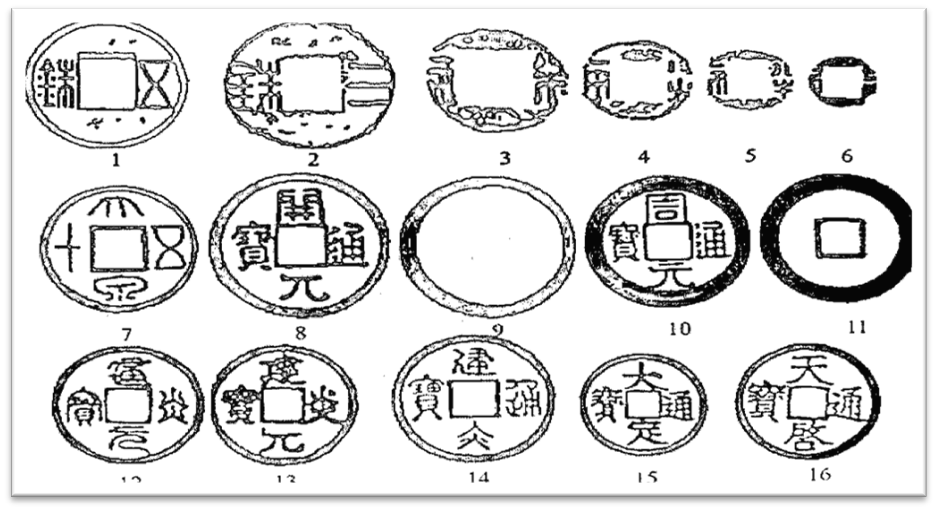
Figure 2. Ancient Currencies of China (1- Han Dynasty Wu Zhu, 2- Han Dynasty San Zhu, 3-6- Han Dynasty Yu Jia, 7- Wang Mang Da Quan Wu Shi, 8-9- Tang Dynasty Kai Yuan Tong Bao, 10-11- Southern Zhou Dynasty Zhou Yuan Tong Bao, 12-13- Song Dynasty Jian Yuan Tong Bao (obverse and reverse), 14- Song Dynasty Jian Yan Tong Bao (obverse and reverse), 15- Jin Dynasty Da Ding Tong Bao, 16- Yuan Dynasty Tian Qi Tong Bao)(Pollard and Ruiliang 4).
In 1227, a series of military-related uprisings emerged in Ozhou (博州) in Shandong Province (Shusen 825). The economic crisis that followed these rebellions led administrators to turn to the hui[-tzu] (會子) currency which facilitated transactions between landowners and merchants (YS 3552).
Yeh-lu Ch’u Ts’ai, an advisor to Ögedei, played a pioneering role in introducing the Mongols to paper money for the first time (YS 93; Emîn 115; Âkâcerî and Rezevî 214-215; Isfahânîyân 102; Eberhard 200), issuing a limited amount of paper currency called chiao-ch’ao 交鈔 in denominations of 10,000 ding7 (YS 34, 3460; Shaomin 33). In 1251, Bujir of the Tatar tribe, governing Northern China during Möngke Khan’s reign was tasked with printing paper money referred to as Baoch’ao 寶鈔 (valuable money) (YS 3021), reflecting the mobility of currency at that time. William Rubruck, sent as an envoy by the King of France, also noted the existence of imperial-stamped paper money circulating in Karakorum during Möngke Khan’s rule (Rubruck 100-101).
In 1253, Kublai, who took over the military administration of Northern China, implemented some fiscal measures and established a “Exchange Currency Administration” in the Jingzhao region, issuing paper money called chiao-ch’ao 交鈔 (YS 59; Gaohua and Wemin, Zhongguo Jingji Shi: Yuandai Jing 1763). The banknotes he issued differed from those of Möngke Khan and were limited solely to chiao-ch’ao 交鈔. Despite being issued in series, chiao-ch’ao 交鈔 lost significant value and did not gain the expected popularity in circulation. During the Yuan Dynasty, copper coins were generally avoided due to reserve issues. However, coinage was minted during the reign of Ch’eng-tsung (1295-1308); it remained more of a numismatic curiosity than a widely used currency (Katō, “Kanei” 1-14; Franke 134-135).
Paper Money in Circulation during Kublai Khan’s Reign and Its Issuance
Money is considered a medium of exchange for objects a society perceives to have measurable value (Franke 131). In line with this definition, the Mongols issued limited regional paper money.
Table 1
Paper Money of the First Year of the Zhongtong Era during Kublai Khan’s Reign
| Month/Year | Name of Currency | |
|---|---|---|
| July 1260 | Exchange Money (chiao-ch’ao 交鈔) Silk Money (Si-ch’ao 絲鈔) | |
| October 1260 | Zhongtong Silver Coin (Zhongtong Yinhuo 中統銀貨) | |
| October 1260 | Zhongtong Currency (Zhongtong Yuanbaoch’ao 中統元寶鈔) | |
Between 1250 and 1252 Shih Chi, serving as ping-ma tu tsung-kuan 兵馬都總管 under Chen-ting, submitted a petition to the Empress requesting the establishment of stable silver reserves to increase the value of paper money (Franke 133). Because the currency issued at the central mint by the Khan’s decree failed to gain national acceptance, the use of silk banknotes generally remained at a local level. The fact that this petition was addressed to the Empress rather than the Khan reflects this situation (Ch’üan Han-sheng 6-7).
The primary purpose of the significant currency reform in 1260 was not only to consolidate monetary reserves and increase the value of money but also to unify the many different paper currencies circulating in Northern China. To serve this purpose, Kublai Khan linked the jiao-zi 交子 with jiao-ch’ao 交鈔 (Matsui, “Mongol Globalism” 34).
In the early period of Kublai Khan’s reign in 1260, three types of currency were designed: the Exchange Money (chiao-ch’ao 交鈔) and Silk Money (Si-ch’ao 絲鈔) issued in July 1260, and the patterned damask Zhongtong Silver Coin (Zhongtong Yinhuo 中統銀貨) issued in October 1260. However, these currencies could not be fully circulated (Franke 134). The precise reason for attempting to issue three different types of currency in the same year remains unclear. The Zhongtong Yuanbaoch’ao (中統元寶鈔) and Zhongtong Silver Coin (Zhongtong Yinhuo 中統銀貨) were backed by silver reserves while silk reserves backed the chiao-ch’ao 交鈔 currency. The chiao-ch’ao (交鈔) was withdrawn from circulation because the government preferred silver as a reserve instead of silk. From 1260 onward the Zhongtong Yuanbaoch’ao (統元寶鈔) became the principal first paper banknote in use (Angel 239).
During Kublai Khan’s reign, paper money could be exchanged at a fixed rate for silver and gold and freely used for tax payments encouraging the adoption of paper currency. In this context, in 1260, the government issued regulations allowing the pao-yin (保银 / 抱银 / 寶銀) 8 tax to be paid with paper money. By March 1263, the pao-yin tax was paid using paper currency (Franke 134). Gifts given to Mongol bureaucrats in paper money instead of gold, silver or silk were justified by the decline in metal reserves and the difficulty of transporting heavy coins (Vogel 94-95; Hui 301). The export of metal coins and declining reserves threatened the Chinese economy, prompting Kublai Khan, with the support of trusted officials, to take a decisive and radical step toward paper money (Franke 132; Eberhard 264). The domestic population and foreigners were required to exchange the precious metals they brought with them for paper currency (Marco Polo, Dünyanın Hikâye Edilişi, 214; Marco Polo, The Book of Ser Marco Polo 425; Rossabi 120-122; Çandarlıoğlu, “Kubilay” 31-32).
Although denominations of 2, 3 and 5 wen 文 were issued in 1275-1276, by 1278, these smaller units were withdrawn from circulation as they were deemed unsuitable for public use (Franke 139).
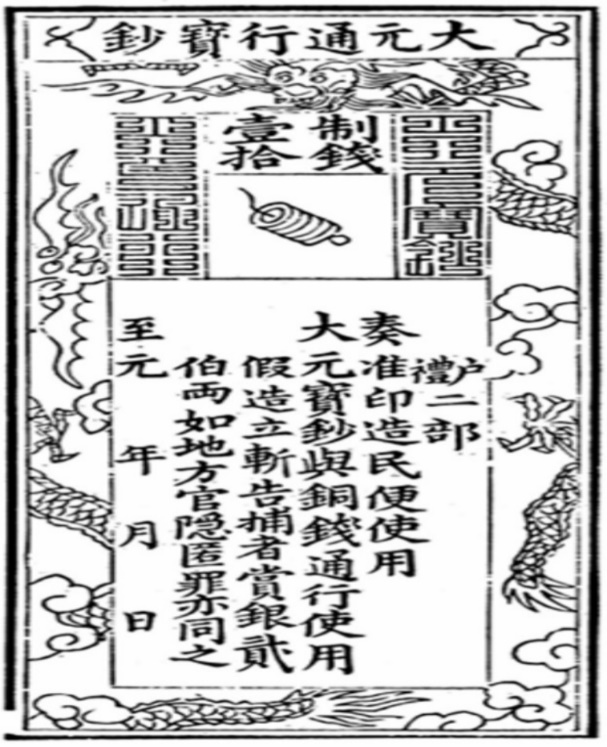
Currency 1. 10 Wen (1264–1294), 2 ¾ × 6 7/8 inches (The first line reads “Great Yuan General Circulation Treasury Note” and the second reads “Ten Copper Kuan” In a stamp-like style, the inscription is on the right side of the note: “Chih-yuan Treasury Note”) (Davis 581).
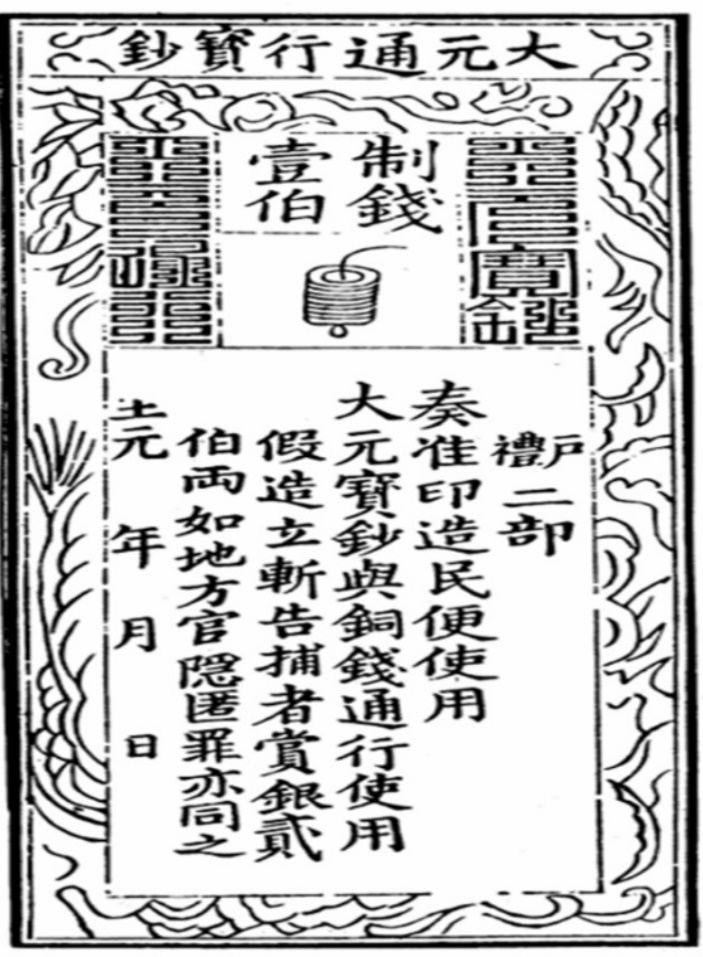
Currency 2: 100 Copper Coins (1264-1294), 3 × 7 ½ inches (This note is similar to the 10 Wen banknote, with the addition of indicating 100 copper coins and minor differences in the border decorations) (Davis 588).
The paper money examples above were printed in grey during Kublai Khan’s reign. Although the Yuan-pao chiao-ch’ao 元寶交鈔 circulated for a long time, rising prices of goods gradually caused the paper money to lose value. Therefore 1287, a new paper currency called Zhiyuanch’ao 至元鈔 was issued. This currency was printed in eleven denominations, ranging from 2 qian to 5 wen. These circulated alongside the Zhongtong paper money and were considered equivalent, with five qian equal to 5 wen (Franke 139). Between 1287 and 1288, this currency was issued in ten new denominations at an exchange rate of 1:5 relative to the old Zhongtong currency and maintained stability for approximately 23 years (Franke 57-59).
In 1294, the Mongols also issued paper money called Chav during the Ilkhanate period. However, it was unsuccessful because the population had long used gold and silver as currency and was resistant to innovations (Mîrhând 368-371; Hândmîr 137; Müstevfî 601; Kirmânî 110; Dihhudâ 7045; Emîn 105; Baron 47-49; Yuvalı 158; Togan 9). In Ilkhanid paper money, the Uighur script and language predominated while Farsi strongly influenced coin inscriptions (Yârahmedî 40).
Table 2
Uighur Donation Records
| Row No | |||
|---|---|---|---|
| 13-14 | 1 siǰir | 3 baqïr | 3 vun čao |
| 25-26 | 2 siǰir | 3 baqïr | 7 vun čao |
| 47-48 | 5 siǰir | 7 baqïr | 3 vun čao |
| 52-54 | 2 siǰir | 2 baqïr | 9 vun čao |
Source: Sertkaya 117-137.
Uighur Donation Records and Paper Money Administration under Kublai Khan
The table above presents Uighur donation records, which are concrete evidence that the Uighurs were integrated into the Yuan-centred monetary system rather than merely reflecting simple accounting data.
In the early period, wooden plates were used for printing paper money, but by 1276, these plates were replaced with copper casts (Franke 139). In the same year, alongside the spread of papermaking technology, a paper factory was established in Montefano, Italy and by 1293, a branch was opened (Groseclose 119). However, Europeans never achieved the same level of centralised authority as in China and their experiments with paper money remained anomalies.
During Kublai Khan’s reign, a mint was established in the capital, Khanbaliq, to print paper money. Each note carried the signature of the money officer and a blue seal while the Khan’s red seal, roughly the size of a palm, authenticated the note (Ibn Battûta 896; Rockhill 201-202). These seals verified the validity of the currency, and their designs were generally rectangular. Banknotes were printed in proportion to their denominations (Marco Polo, Dünyanın Hikâye Edilişi, 212-213; Marco Polo, The Book of Ser Marco Polo 423-424; D’ohsson 227-228; Çandarlıoğlu, “Kubilay” 31) and were primarily used in place of dinars and dirhams (Ibn Battûta 896).
Paper money was not only issued by the central government; some local administrators were also given printing plates and authorised to issue notes (Williams 155-156). These banknotes were distinguished by darker black and red seal colours. The design of banknotes was not uniform across all regions, with Northern China being the primary focus (Mote 766). Banknotes issued for a specific city could only circulate locally (Wang Yun 8a9-bl). Besides the right of the government to print paper money, temples and specific private individuals were also granted the right to mint coins (Ching-hua tzu-tien 23; Franke 135).
Problems in monetary reserves sometimes caused periodic depreciation in the value of paper money. Each note was stamped by a limited number of officials specially assigned for this task, under the supervision of a senior official appointed by the Han administration. The official pressed the seal into ink and stamped the note, giving it legal validity. Attempting to forge such notes was considered a crime.
Currency Exchange Centres
Under Yuan rule, all people in regions and cities were required to recognise paper money (D’Ohsson 242; Jahn 300-301). Due to decreasing metal reserves and treasury shortages, Kublai Khan introduced reforms, making the exchange of precious metals for paper money compulsory. Anyone wishing to obtain gold or silver for commercial purposes had to request it from the mint. During this period, the phrase “Property and Chav belong to the Khan” was used, with “chav” beginning to circulate as an exchange for gold and silver, valued at 12 dinars per chav (Ibn Battûta 903).
To support exchanges, offices functioning as currency exchange centres were established (Gaohua and Weimin, Zhongguo Jingji Tongshi 2002). These offices facilitated converting metal to paper money and replaced worn or damaged banknotes (YS 23, 515). Because these centres also performed banking functions, their services were comprehensive. The first such office was the Xingyongku 行用庫. The first operational exchange office was the Zhongdu Xingyongku Exchange Bank (Farquhar 179-180). Foreign merchants conducting trade were served by the Pingzhunku 平准庫 or Standard Exchange Administration (Gaohua and Weimin, Zhongguo Jingji Tongshi 2002). Later, Price Stabilisation/Exchange Banks (Pingzheng Xingyongku 平準行用庫) were established in various regions (Farquhar 179-180). These banks could replace worn notes and handle gold and silver transactions. Locals could also bring silk threads, plain-weave threads and other textiles to calculate and settle payments (YS 23, 515). Individual exchanges of gold and silver were prohibited; all conversions had to occur at the official offices (Khrapachevskiy 114, 238n.).
The policies initiated at the start of the Zhongtong era established Lu (魯) provincial treasury offices to regulate gold and silver trade and stabilise the paper money system. Each hua-yin 花銀 (a type of refined silver) 9 deposited in the treasury was valued at two qian five fen and each red gold liang (赤金, ch’ih-chin) 10 was valued at 20 qian when deposited and 20 qian 500 wen when disbursed (Franke 139).
In June 1263, the Yanjing Stabilisation Bank (Pingzhunku 平準庫) was established to balance commodity prices in paper currency, prevent inflation and deflation, and channel precious metals, especially silver and gold, into the state treasury (YS 93, 2370). Officials in this institution included Chinese and many Muslim merchants (YS 5, 92; Khrapachevskiy 93). Until paper banknotes became widespread, silk-based currency was exchanged at these banks. When worn-out notes were replaced, the value of new notes was reduced to cover ink and labour costs: 30 wen until 1267, 20 wen until 1286, and then returned to 30 wen (Schurmann 140; Franke 139).
Old banknotes collected in each region were submitted quarterly by provincial officials (Zhengguan 正官) under the Central Secretariat and Ministry of Revenue (Hubu 戶部) to be burned (YS 93, 2370; Schurmann 140).
In May 1272, the 9th year of the Zhiyuan era, the Exchange Money Bank (Jiao-ch’ao Tiju-si 交鈔提舉司) was established in Karakorum (YS 141; Shaomin 1628). By October 1283, the Standard Exchange Administration was established there to oversee the conversion of gold, silver, and other valuables into paper currency (YS 258; Shaomin 1628). In March 1280, a local Exchange Money Bank was set up in the Uighur region and in March 1283, a Jiao-ch’ao-ku 交鈔庫 was established to verify the authenticity and circulation of paper money (YS 252; Shaomin 1628; Yanbin, 276).
After his Southern China campaign in 1275, Kublai Khan ordered that the Jiaozi and Huizi currencies be exchanged for Zhongtong currency (YS 4560; Shaomin 3262; T’ang 95-396). Accordingly, 50 qian of Huizi was fixed at one guan of Zhongtong (YS 2393). By January 1276, Kublai had established 11 Exchange Banks (Huiyiku 回易庫) across all regions. The primary function of these banks initiated in 1260, was to fix the value of precious metals like gold and silver, facilitate the conversion to paper money, and manage trade. By 1276, these banks were also authorised to control the supply of paper money and goods equivalent to silk and currency (YS 9, 175; Khrapachevskiy 271, 297, 15n.).
By 1279, after the Song Dynasty came under Yuan control, the population initially continued using their old currencies instead of exchanging them. Authorities allowed 50 days for people to exchange their notes; those who complied were exempt from penalties, while non-compliers were punished. Informants reporting violations were rewarded (Yuan Dianzhang 748).
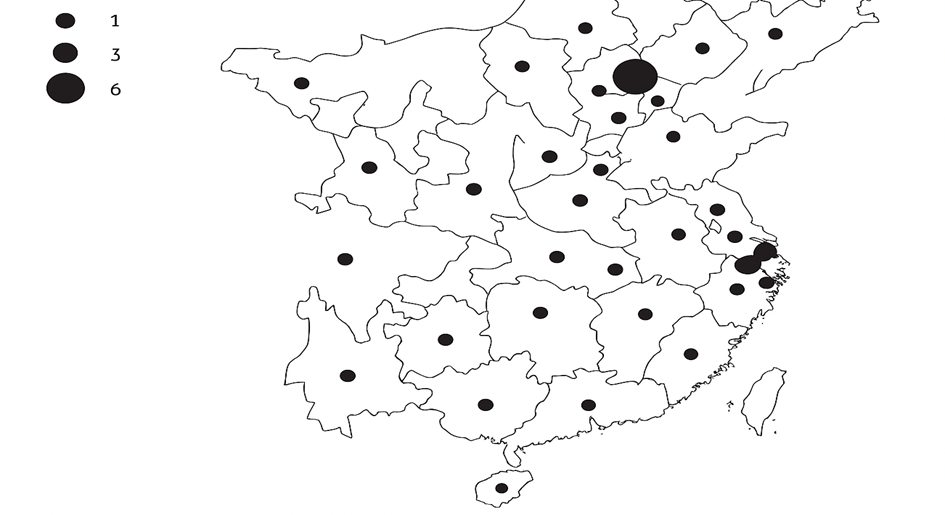
Map 1. A map showing silver exchange offices according to the administrative divisions 1290 (Yuan Dianzhang 321).
The map indicates the Lu 路, Fu 府 and Zhou 州 exchange offices in cities that had reached the provincial level under the Yuan dynasty. The population had the right to acquire new banknotes by paying a small % commission fee of 3% (Vogel 112; Glahn, Fountain 58). Six silver exchange offices were located in Dadu’s capital, three in Yangzhou and the remaining offices were distributed across different cities. As shown on the map, these offices were concentrated in eastern China.
The destruction of worn-out notes was also practised. Until 1291, notes were destroyed at incineration centres in Dadu; afterwards, these centres were closed and old paper money was burned within their respective regions (Franke 44-45). Delivered banknotes were scheduled to be burned every 25 years by officials responsible for tax collection, under the supervision of the Chung-shu-sheng/ Hu-bu (Franke 139).
Units and Equivalents of Currency Used during the Yuan Dynasty
The Zhongtong Silver Currency (Zhongtong Yinhuo 中統銀貨), designed in October 1260 was not put into circulation. This currency was issued in five denominations-1, 2, 3, 5 and 10 liang liang, equivalent to 1 liang of white silver (Franke 40-41, 138).
Only the Zhongtong Currency (Zhongtong Yuanbaoch’ao 中統元寶鈔), also designed in October 1260 (Ch’üan Han-sheng 36-44), was circulated. It was issued in nine denominations: 10, 20, 30, 50, 100, 200, 500 wen 文, 1 and 2 guan 贯 (YS 2369; Shaomin 1627; Ji 5).
Table 3
Currency Terms and Denominations Used during the Reign of Kublai Khan
| Weight (Grams) | Mongolian | Chinese | Uighur | Persian |
|---|---|---|---|---|
| 200 | süke | ding 錠 | yastuq | baliş11 |
| 40 | siǰir | liang 兩 (Matsui, “Mongol Globalism” 34) | stïr/sïtïr | sīr |
| 4 | bakir/baqir | qian 錢 (Matsui, “Mongol Globalism” 34; Wu 103-104). | baqïr | misqāl (Togan 7; Yuvalı 159). |
| - | vun | fen 分 (Naonori 19-20; Takao 29-31). | - | vun |
Guan 贯, wen 文, fen 分, li 釐, suo 索 are currency units used during this period, representing smaller denominations. Among them, fen 分 was considered the smallest unit of currency in China (Matsui, “Mongol Globalism” 35).
Table 4
Equivalents of Currency Units
| Ding | Liang | Qian | Wen | Fen | Suo | Li |
|---|---|---|---|---|---|---|
| 1ding 錠 | 50 liang 兩(Hui 299) | 50 qian 錢 | - | - | - | - |
| - | 1liang 兩 | 10 qian 錢(Shusen 443) | - | - | - | - |
| - | 1 liang 兩 | 1qian 錢 | 100 wen文 | - | 20 suo 索 | - |
| - | - | - | 10 wen文 | - | - | - |
| - | - | - | 1wen文 (Yongwei 7) | 1 fen 分 | - | - |
| - | - | - | - | - | - | 1 li 釐 |
Each one wen was considered equivalent to 10 wen Chih-ta t’ung-pao (metal coins). Copper coins from previous dynasties continued to circulate alongside the Chih-ta copper coins by traditional practices, and larger denomination coins such as tang-wu 當五, tang-san 當三 and che-erh 折二 retained their former values12 (Yasaburō 307c).
Table 5
Values of Yuan Dynasty Paper Money by Year
| Circulation Period | Zhongtong Paper Money (Guan) | First Zhida Paper Money (liang) | Zhiyuan Paper Money (Guan) | Second Zhiyuan Paper Money (Guan) | Zhizheng Paper Money (Guan) | Silver (liang) |
|---|---|---|---|---|---|---|
| Zhongtong Paper Money (Guan) 1260-1286 | 1 | - | - | - | - | 0,5 |
| First Zhida Paper Money (liang) 1287-1309 | 5 | 1 | - | - | - | 0,5 |
| Zhiyuan Paper Money (Guan) 1310 | 25 | 5 | 1 | - | - | 1 |
| Second Zhiyuan Paper Money (Guan) 1311-1351 | 5 | 1 | - | 1 | - | 1 |
| Zhizheng Paper Money (Guan) 1352-1368 | 10 | 2 | - | - | 1 | 1 |
Source: Miyazawa 55.
Conclusion
The reign of Kublai Khan represents a critical period in which Mongol political traditions and China’s established bureaucratic and economic structures were synthesised. The formal adoption of paper money as the state’s official payment medium was a financial innovation and a significant manifestation of administrative centralisation and legitimacy production. While the use of paper money in previous dynasties had been limited to specific regions, Kublai Khan transformed it into a state policy for fiscal and political reasons. Restrictions were placed on metal currency, with exchanges conducted in paper money to ensure wealth accumulation within the state treasury. The Zhongtong and Zhiyuan series, issued against silver and silk reserves, consolidated local currencies under a single system.
The establishment of exchange banks and currency offices in different cities regulated the flow of money and made the state’s administrative presence in the provinces visible. Collecting taxes and conducting official payments through paper money reinforced its legitimacy in the eyes of society. Forcing foreign merchants to convert their precious metals into paper money enabled the Mongols to implement a fixed exchange rate regime and direct capital accumulation in a state-centred manner. Consequently, using paper money under Kublai Khan went beyond addressing economic necessities, becoming a vital tool for consolidating imperial power. This system allowed the central authority to control monetary circulation and served an ideological function, binding diverse ethnic and geographic groups within the empire.
Author Contributions
The authors’ contribution rates in this study are equal.
Conflict of Interest Statement
There is no conflict of interest with any institution or person within the scope of this study. There is no conflict of interest between the authors.
- Fei-ch’ien 飛錢, meaning “flying money” was a monetary system that appeared in the mid-eighth century in which cash transfers were carried out through promissory notes and remittance certificates. Although this system first emerged as a private sector practice, it was monopolised by the Tang Dynasty in the early ninth century (Miyazaki 148-182; Twitchett 72-73).
- Chiao-tzu, which initially appeared as a cash transfer voucher, evolved into a fully fledged paper currency by the late eleventh century (Katō, “Köshi” 78-80).
- Hui-tzu refers to the paper money used by the Southern Song Dynasty (Kaizaburō 1-40).
- In 1154 during the Jin Dynasty, paper money was put into circulation; however, as this currency quickly lost its value, silver became the principal medium of exchange (Hou-tzu, 254-267).
- Tzu-mu hsiang-ch’uan 字母相权 means “paper money” (Harvard Yenching Institute 68, 27).
- This currency was named after the guan the accounting unit used for copper coins. Jiaozi was issued in denominations of 500 wen and 1 guan. Wen (文) was the smallest accounting unit of copper coinage. During the Song Dynasty, a string (guan, 串/貫) consisting of 770 wen worth of copper coins was referred to as “1 guan” (Peng 400; Glahn, “Monies of Account” 465).
- Ding 錠 was a unit of account for silver, with 1 ding of silver being equivalent to 50 liang of silver. The Yuan government used ding as an accounting unit for recording fiscal revenues and expenditures and 1 ding was regarded as equal to 50 guan of Zhongtong paper currency (YS, 35-44; Liu 142-143).
- Pao-yin (保银 / 抱银 / 寶銀) refers to a type of tax or fiscal obligation paid in a fixed amount of silver, especially practiced during the Yuan and Ming dynasties (Glahn, “Monies of Account” 470; Hucker 152 ff.).
- During the Yuan Dynasty, silver circulated in various degrees of purity. There were eleven different grades, ranging from 100% to 97.5% purity (Katō, Tō Sō 284).
- Ch’ih-chin means “red gold” (Chang 320-322).
- Bāliš (*čāv <Uighur-Mongol čao <Chinese 鈔 ch’ao) is valued at 50 sĦr, which is equivalent to 10 dinars; however, a bāliš made of gold or silver ingots weighs 500 misqāl (Şîrâzî 22; Yuvalı 159; Togan 7). Additionally, in Uighur 必兒米思哈 (one misqāl)-derived from Persian misqāl-this unit is interpreted in the Ming-period Chinese-Uighur dictionary 畏兀兒館譯語 (Wei-wu-er-guan yiyu) as the Chinese qian (one qian) (Masahiro 157,825n.; Matsui, Unification 200; Matsui, “Mongol Globalism” 34).
- In 1071 a shortage in copper reserves led to the circulation of iron coins in the Shanxi region. Each of these coins was equivalent to 2 wen and thus they were called che-erh. During the same period, Tang-shih coins (i.e., coins valued at 10 wen) were also issued (Ding 52b-53a; Yasaburō 307c).
Görsel, Şekil ve Tablolar
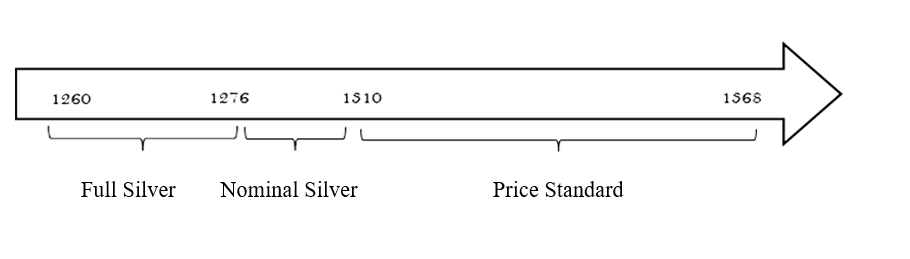
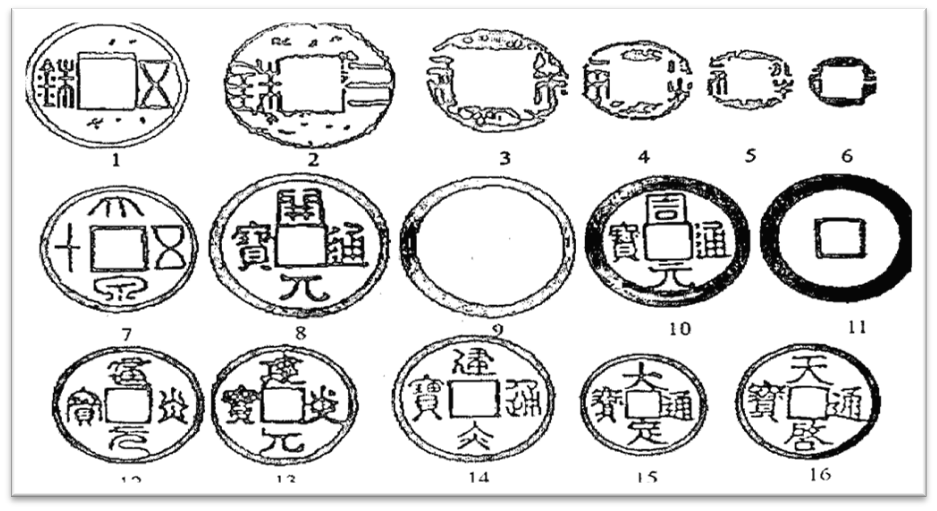
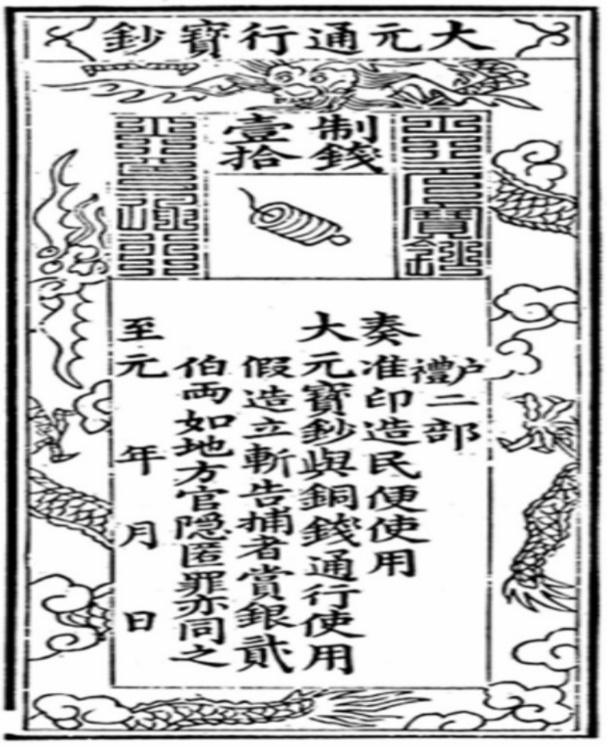
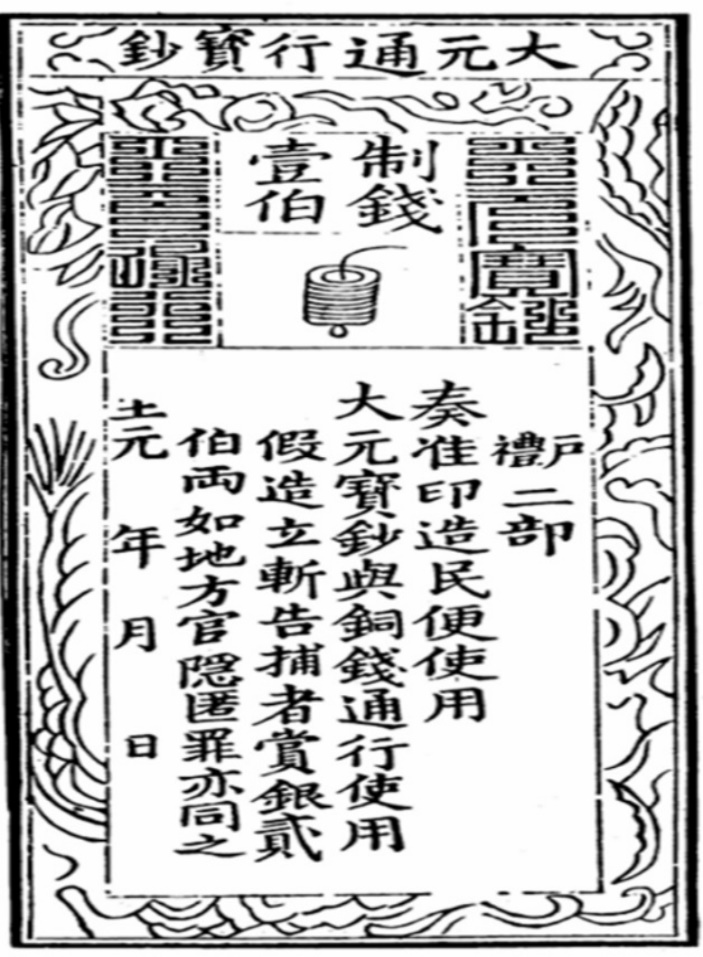
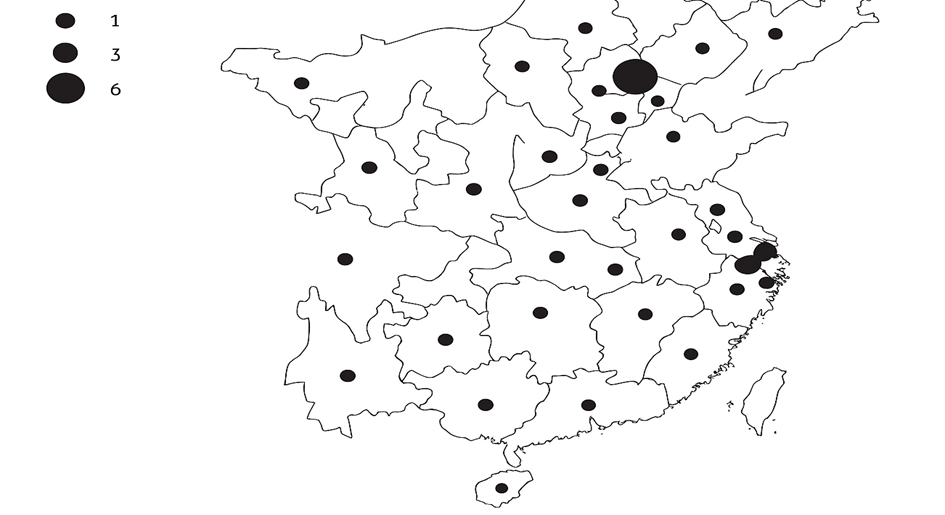
Table 1. Paper Money of the First Year of the Zhongtong Era during Kublai Khan’s Reign Tabloyu gösterTabloyu gizle
| Month/Year | Name of Currency | |
|---|---|---|
| July 1260 | Exchange Money (chiao-ch’ao 交鈔) Silk Money (Si-ch’ao 絲鈔) | |
| October 1260 | Zhongtong Silver Coin (Zhongtong Yinhuo 中統銀貨) | |
| October 1260 | Zhongtong Currency (Zhongtong Yuanbaoch’ao 中統元寶鈔) | |
Table 2. Uighur Donation Records Tabloyu gösterTabloyu gizle
| Row No | |||
|---|---|---|---|
| 13-14 | 1 siǰir | 3 baqïr | 3 vun čao |
| 25-26 | 2 siǰir | 3 baqïr | 7 vun čao |
| 47-48 | 5 siǰir | 7 baqïr | 3 vun čao |
| 52-54 | 2 siǰir | 2 baqïr | 9 vun čao |
Table 3. Currency Terms and Denominations Used during the Reign of Kublai Khan Tabloyu gösterTabloyu gizle
| Weight (Grams) | Mongolian | Chinese | Uighur | Persian |
|---|---|---|---|---|
| 200 | süke | ding 錠 | yastuq | baliş |
| 40 | siǰir | liang 兩 (Matsui, “Mongol Globalism” 34) | stïr/sïtïr | sīr |
| 4 | bakir/baqir | qian 錢 (Matsui, “Mongol Globalism” 34; Wu 103-104). | baqïr | misqāl (Togan 7; Yuvalı 159). |
| - | vun | fen 分 (Naonori 19-20; Takao 29-31). | - | vun |
Table 4. Equivalents of Currency Units Tabloyu gösterTabloyu gizle
| Ding | Liang | Qian | Wen | Fen | Suo | Li |
|---|---|---|---|---|---|---|
| 1ding 錠 | 50 liang 兩(Hui 299) | 50 qian 錢 | - | - | - | - |
| - | 1liang 兩 | 10 qian 錢(Shusen 443) | - | - | - | - |
| - | 1 liang 兩 | 1qian 錢 | 100 wen文 | - | 20 suo 索 | - |
| - | - | - | 10 wen文 | - | - | - |
| - | - | - | 1wen文 (Yongwei 7) | 1 fen 分 | - | - |
| - | - | - | - | - | - | 1 li 釐 |
Table 5. Values of Yuan Dynasty Paper Money by Year Tabloyu gösterTabloyu gizle
| Circulation Period | Zhongtong Paper Money (Guan) | First Zhida Paper Money (liang) | Zhiyuan Paper Money (Guan) | Second Zhiyuan Paper Money (Guan) | Zhizheng Paper Money (Guan) | Silver (liang) |
|---|---|---|---|---|---|---|
| Zhongtong Paper Money (Guan) 1260-1286 | 1 | - | - | - | - | 0,5 |
| First Zhida Paper Money (liang) 1287-1309 | 5 | 1 | - | - | - | 0,5 |
| Zhiyuan Paper Money (Guan) 1310 | 25 | 5 | 1 | - | - | 1 |
| Second Zhiyuan Paper Money (Guan) 1311-1351 | 5 | 1 | - | 1 | - | 1 |
| Zhizheng Paper Money (Guan) 1352-1368 | 10 | 2 | - | - | 1 | 1 |
Kaynakça
- Âkâcerî, S. H., and S. E. Rezevî. “İlel Nâkârkerdî Pûl-i Kâgızî der İktisâd ve Câme’i ‘Asr-i Îlhânî.” Pejûheşnâme-i Dânişgede-i Edebiyât, no. 38, Dâniş gâh-i Şehîd Beheştî, 1382 hş.
- Angell, Norman. The Story of Money. Garden City Publishing Co, 1929.
- Anonim. Yuan Dianzhang 元典章. prep.by. Hong Jinfu 洪金富. Zhongyang Yanjiuyuan Lishi Yuyan Yanjiusuo 中央研究院歷史語言研究所, Taiwan Taibei 臺灣台北 2016; Da Yuan shengzheng guochao dianzhang (大元聖政國朝典章) (Yuan dianzhang. Zhonghua Shuju, Beijing 1964.Baron, Edward. Ez Sa’dî tâ Câmî’Asr-ı İstilâ-yı Mogûl ve Tâtâr. trans. Ali Asger Hikmet, İntişârât-ı İbn-i Sînâ, Tahrân 1301 hş.
- Biot, Édouard Constant. Le Tcheou-li; ou, Rites des Tcheou (Zhouli). vol. I, Paris 1851.
- Carradice, Ian, and Mart’in Price. Hellen Dünyasında Sikke. Trans. Oğuz Tekin, Homer Kitabevi Press, 2001.
- Chang, Hung-chao (ed). Shih Ya 石雅. Geological Survey of China, Peiping 1927.
- Ch’üan Han-sheng. “Yuan-tai te chih-pi.” Chung yang yen chiu yü lĭ-shĭ yǔ yán yán-jiū suǒ chī-kān, no. 15, 1948, pp. 1-42.
- Ching-hua tzu-tien 清華字典. comp. Ting Fu-pao. Shangwu yinshuguan 商務印書館. The Commercial Press, 1915.
- Çandarlıoğlu, Gülçin. “Kubilay (1259-1294) ve Ulcay Timur Kaan (1294-1307) Zamanları.” Bozkurt’un Ejderha ile Dansı: Türk-Çin İlişkilerinin Kısa Tarihi, Türk Dünyası Araştırmaları Vakfı, 2018.
- Çandarlıoğlu, Gülçin. “Uygur Devletleri Tarihi ve Kültürü.” Türkler Ansiklopedisi, vol. II, 2002.
- Davis, Andrew McF., and Kojiro Tomita. “Ancient Chinese Paper Money as Described in a Chinese Work on Numismatics.” Proceedings of the American Academy of Arts and Sciences, vol. 53, no. 7, 1918, pp. 467–647.
- Daquan, Jia 賈大泉. “Xue Tian shi Woguo he shijieshang zuizao de jiechu de zhibi zhuanjia.” 薛田是我國和世界上最早的杰出的紙幣專家. Xinan jinrong 7, 1994.
- Dihhudâ, Alîakber. “Çav.” Lughatnâme-i Dihhudâ, prep. Muhammed Mu’în-Seyyid Ca’fer Şehîdî, vol. V, Çâp-i Dânişgâh-i Tahrân, 1373 hş., pp. 7045.
- Ding, Fubao 丁福保 ed. Gu Qian Da Cidian 古錢大辭典 (Great Dictionary of Ancient Chinese Coins). Yixue Shuju 醫學書局, Shanghai 1938.
- D’Ohsson, A. Konstantin. Moğol Tarihi. Trans. Bahadır Apaydın. Nesnel Press, 2008.
- Eberhard, Wolfram. Çin Tarihi. TTK Press, 2019.
- Ederer, Rupert J. The Evolution of Money. DC: Public Affairs Press, 1964.
- Emîn, Şemîs Şerîk. Istılâhât-i Dîvân-i Dovrân-i Mogûl. İntişârât-i Ferheng-i Edeb ve Hüner-i Îrân, 1357 hş.
- Farquhar, David M. The Government of China Under Mongolian Rule (A Reference Guide). Franz Steiner Verlag, Stuttgart 1990.
- Franke, Herbert. Geld und Wirtschaft in China unter der Mongolen-Herrschaft: Beiträge zur Wirtschaftsgeschichte der Yüan-Zeit. Otto Harrassowitz, 1949.
- Gaohua, Chen 陈高华, and Shi Weimin 史卫民. Zhongguo Jingji Shi: Yuandai Jingji 中国经济通史: 元代经济. Zhongguo Shehui Kexue Chubanshe 中国社会科学出版社, vol. I, 2007.
- Gaohua, Chen 陈高华, and Shi Weimin 史卫民. Zhongguo Jingji Tongshi (中国经济通史/Comprehensive Economic History of China). vol. II, Zhongguo Renmin Daxue Chubanshe (中国人民大学出版社).
- Glahn, Richard Von. “Monies of Account and Monetary Transition in China.” Twelfth to Fourteenth Centuries.” Journal of the Economic and Social History of the Orient, vol. 53, no. 3, 2010, pp. 463-505.
- Glahn, Richard Von. “State Formation in China.” The Economic History of China: From Antiquity to the Nineteenth Century, Cambridge University Press, 2016, pp. 33-67.
- Glahn, Richard Von. “The Origins of Paper Money in China.” The Origins of Value: The Financial Innovations That Created Modern Capital Markets, eds. Goetzmann, William N., and K. Geert Rouwenhorst, Oxford University Press, 2005, pp. 65-91.
- Glahn, Richard Von. Fountain of fortune: money and monetarypolicy in China 1000-1700, 1996.
- Han, Xu (ed.). Zhongguo Lishi Baike Quanshu: Shehui Jingji (中国历史百科全书·社会经济, 徐寒). Vol. 5, Jilin Daxue Chubanshe 吉林大学出版社, 2004.
- Hândmîr, Gıyâseddîn b. Humâmeddîn el-Hüseynî. Habîbu’s-Siyer. Rev. Doktor Muhammed Debîr Siyâkî, vol. III, Kitâbfurûş-i Hayyâm, 1333 hş.
- Harvard-Yenching Institute. Chinese-English Dictionary Project. Fascicle 39.0.1: Preliminary Print, Harvard University Press, 1953.
- Hou-tzu, Liu. “Sung Chin i-lai chih chao-pi” [宋金以來之鈔幣/ “Papiergeld seit der Sung- und Chin-Zeit.” Chung-te Hsüeh-chih (中德學誌 /Aus deutschen Geistesleben) 6, 1944.
- Hucker, Charles O. A Dictionary of Official Titles in Imperial China. Stanford University Press, 1985.
- Hui, Wu 吴慧. Zhongguo Shangye Tongshi 中国商业通史. Vol. 3, Beijing Caizheng Jingji Chubanshe 中国财政经济出版社, 2005.
- Isfahânîyân, D. “Nohestîn Pûl-i Kâgizî der Îrân.” Berresîhâyî Târîhî, no. 77, 1357 hş., pp. 97-106.
- Ibn Battûta Tancî, Ebû Abdullah Muhammed. İbn Battûta Seyahatnâmesi. Trans. A. Sait Aykut, Yapı Kredi Press, 2004.
- Jahn, Karl. “İran’da Kâğıt Para.” Trans. Mehmet Altay Köymen, Belleten, no. VI, 1942, pp. 269-309.
- Ji, Tu 屠寄. Mengwuer Shiji 蒙兀兒史記. Vol. 3, Pilingtushi 毗陵屠氏,1934.
- Jiaben, Shen 沈家本. Lidai Xingfa Kao 历代刑法考. Vol. 1, Shangwu Yinshuguan 商务印书馆, 2011.
- Kaizaburō, Hino. “Nansō Rin’an no shika kaishi ni tsuite” 南宋臨安の私家會子について / “Concerning Private Hui-tzu in Lin-an during the Southern Sung.” Shakai Keizai Shi Gaku (社会経済史学 / Journal of Social and Economic History, no. 11, 1941, pp. 1-40.
- Katō, Shigeru 加藤 繁. Tō Sō jidai ni okeru kingin no kenkyū (唐宋時代に於ける金銀の研) Center for Economic Research and Documentation (CERDDF), Tokyo 1925-1926.
- Katō, Shigeru 加藤繁. “Kanei to naritaru nochi no ekishu kōshi: Tiaozi ido no seido ga seifu ni yotte tottae rareta nochi.” (Die Organisation von Tschiao-se ido nach Übernahme durch die Regierung), (寛永となりたる後の駅輸交子:「交子移動」の制度が政府によって取上げられた後), Shigaku Zasshi (史学雑誌), vol. 45, 1935, pp. 1-14.
- Katō, Shigeru (加藤繁). “Köshi, kaishi, kanshi to iu kotoba no imi ni tsuite.” 交子會子器子といふ語の意味について, THGH, (Tōkyō) 6, 1936, pp. 73-80.
- Kirmânî, Nâsireddîn Münşî. Nesâ’imü’l-Ashâr min Letâ’imü’l-Ahbâr der Târîh-i Vüzerâ. rev. by. Mîr Celâled dîn Hüseynî Urmevî, İntişârât-i Dânişgâh-i Tahrân, n.d.
- Khrapachevskiy, R. P. “Annalı Hubilaya” Glavnıy İstoçnik po İstorii Pravleniya Pervogo İmperatora Dinastii Yuan’ (Tszyuani 4-17 “Yuan’ Şi”). Tsentr po İzuçeniyu Voennoy i Obşçey İstorii, 2019.
- Liu, Sen 劉森. “Yuandai chaoben chutan 元代鈔本初探 (Preliminary study of the money reserves in the Yuan Dynasty).” Journal of Henan University (Social Science), no. 2, 2007, pp. 135-143.
- Marco Polo. Dünyanın Hikâye Edilişi. Trans. Işık Ergüden and Z. Zühre İlkgelen, Ötüken Press, 2019.
- Marco Polo. The Book of Ser Marco Polo: The Venetian Concerning The Kingdoms and Marvels of the East. Ed. Henry Yule, and John Murray, vol. I, 1903.
- Mîrhând. Târîh-i Ravzatu’s-Safâ. Vol. V, Pîrûz, 1339 hş.
- Masahiro 庄垣内, Shōgaito. Uighur manuscripts in St. Petersburg. (正弘ロγア所藏ウイάϧ語文獻の研究), 2003.
- Matsui, Dai 松井 太. “Mongol Globalism Attested by the Uigur and Mongol Documents from East Turkestan.” Studies in the Humanities Cultural Sciences, no. 22, 2009, pp. 33-42.
- Matsui, Dai 松井 太. “Unification of Weights and Measures by the Mongol Empire asSeen in the Uigur and Mongol Documents.” Turfan Revisited, ed. D. Durkin-Meisterernst et al., 2004, pp. 197-200.
- Miyazaki, Michizaburō. “Tōdai no chashō to hisen” “Fei-ch’ien and Tea Merchants of the T’ang Dynasty.” Hōsei-shi Ronshū, 1929, pp. 148-182.
- Miyazawa, Tomoyuki 宮澤知之. “Public finance and the issuance of paper money in Yuan China.” Buddhism University (佛教大学), Symposium of the Division of History Research (歴史学部論集), no. 2, 2012, pp. 43-64.
- Mote, F.W. Imperial China: 900-1800, Harvard University Press, 1999.
- Mu, Qian 錢穆. Guoshi Dagang 國史大綱. Shangwu Yinshuguan 商務印書館, 1994.
- Müstevfî Kazvînî, Hamdullah Ebî Bekr b. Ahmed b. Nasr. Târîh-i Guzîde. Prep. Abdulhüseyn Nevâ’î, İntişârât-ı Emîr Kebîr, 1387 hş.
- Naonori, Maeda 前田 直典. Historical Studies in the Yuan Dynasty. (元朝史の研究), 1973.
- Özyetgin, Melek. “Eski Türklerde Ödeme Araçları: Kâğıt Para Çav’ın Kullanımı.” Modern Türklük Araştırmaları Dergisi, vol. 1, no. 1, 2004, pp. 90-105.
- Peng, Xinwei. A Monetary History of China. Trans. H. Kaplan, Western Washington University, Center for East Asian Studies, 1994.
- Pollard A. M., and Ruiliang Liu. “Chemical studies of Chinese coinage from Qin to Yuan (221 BCE-1368 CE).” Heritage Science, no. 9, 2021, pp. 1-15.
- Rockhill, W. W. The Journey of Willian of Rubruck to the Eastern Parts of the World 1253-1255. 1900.
- Rossabi, Morris. Khubilai Khan: His Life and Times. University of California Press, 1988.
- Rubruck, Wilhelm Von. Moğolların Büyük Hanına Seyahat. Trans. Ergin Ayan, Ayışığı Press, 2012.
- Sertkaya, Osman Fikri. “Hukukî Uygur Belgelerindeki Para Birimleri Üzerine.” Eski Türklerde Para, 2006, pp. 117-137.
- Shaomin, Ke 柯劭忞. Xin Yuanshi 新元史. Jilin Renmin Chubanshe 吉林人民出版社, 1995.
- Shusen, Qiu 邱树森. Yuanshi Cidian 元史辞典. Shandong Jiaoyu Chubanshe 山东教育出版社, 2002.
- Şehâbeddîn Abdullah b. Fazlullah Şîrâzî. Tahrîr-i Târîh-i şirasâf. Rev. Abdulmuhammed Âyetî, İntişârât-ı Bonyâd-ı Ferheng-i Îrân, 1346 hş.
- T’ang, Ch’i. Moğol Sülâlesi Devrinde Türk ve İslâm Dünyası ile Temasta Bulunan Şahsiyetler. PhD Dissertation, Department of History, Division of General Turkish History, Faculty of Letters, Istanbul University, 1970.
- Takao, Moriyasu 森安 孝夫. Currencies on the Eastern Part of the Silk Road (γϧΫローυ東部に͓けΔ通貨), ed. T. Moriyasu et al., 中央アδア出土文物論叢 Papers on the Pre-Islamic Documents and Other Materials Unearthed from īentral Asia, 2004.
- Togan, Zeki Velidi. “Moğollar Devrinde Anadolu’nun İktisadî Vaziyeti.” Türk Hukuk ve İktisat Tarihi Mecmuası, vol. I, 1931, pp. 1-42.
- Tullock, Gordon. “Paper Money: A Cycle in Cathay.” Economic History Review, vol. 9, no. 3, 1957, pp. 393-407.
- Twitchett, Denis C. Financial Administration under the T’ang Dynasty. Cambridge University Press, 1970.
- Vogel, Hans Ulrich. Marco Polo Was in China: New Evidence from Currencies, Salts and Revenues. Leiden and Boston, 2013.
- Wang Yun 王惲. Qiujian Xiansheng Daquan Wenji (秋澗先生大全文集). Sibu Congkan Chubian (四部叢刊初編). Shanghai: Commercial Press (商務印書館), 1936
- Williams, Jonathan. Money: A History. St. Martin’s Press, 1997.
- Wu, Han 吳晗. “Yuan shi Shihuo zhi chaofa pu.” (元史食貨志鈔法譜). Zhongguo Shehui Jingji Shi Jikan (中國社會經濟史集刊), vol. 7, no. 2, 1946.
- Yanbin, Shang. Yuan dai Weiwuer ren yanjiu (元代维吾尔人研究). Minzu Chubanshe 民族出版社, 2012.
- Yang, Lien-sheng. Money and Credit in China: A Short History. Harvard University Press, 1952.
- Yârahmedî, M. “Sikkehâyi Devre-i Mogûl.” Roşd-i Âmûzeşî Târîh, no. 38, 1389 hş., pp. 39-42.
- Yasaburō, Shimonaka ed. Tōyō Rekishi Daijiten 東洋歷史大辭典. 下中彌三郎. vol. 9. Shohan Heibonsha, Tokyo 1937-1939.
- Yongwei, Zhang 张永伟. Lun Yuandai Zhibi 论 元代纸币. Shuoshi Xuewen Yanjiu 硕士学位论文, 2013.
- YS: Song, Lian 宋濂. Yuanshi 元史 Zhonghua Shuju 中華書 局, 1976.
- Yuvalı, Abdülkadir. İlhanlılar Tarihi I Kuruluş Devri. Erciyes University Press, 1994.