

Foreword
Dear Readers,
We are presenting our new issue with a special issue announcement. We aim to publish a special issue titled “International Cooperation for Sustainable Development of Kazakhstan” in the coming year. The editor of this special issue will be Prof. Dr. Aida Sagintaeva, Dean of the Faculty of Education, Nazarbayev University. I present to your attention the concept paper of this special issue:
The transformative power of international cooperation is increasingly recognized as a key driver of national development. By facilitating the exchange of knowledge, skills, cultural values, and resources with established partners, such collaborations enhance capacity building, economic growth, technological advancement, cultural enrichment, and innovative practices, particularly in young states. Consequently, these efforts promote growth and development across various domains, including international relations, culture, literature, economics, business, education, public health, policy formation, and sustainable practices, all of which are critical in addressing local and global challenges.
Despite these benefits, the complexities of international cooperation require careful consideration. Issues such as potential inequalities and power imbalances can place young states in a dependent position, limiting their influence on project directions and outcomes and risking the long-term sustainability of development efforts. Furthermore, these dynamics may perpetuate post-colonial relationships, where the transfer of knowledge, resources, and cultural narratives primarily benefits more established partners, potentially sidelining local knowledge and cultural practices. Thus, it is crucial to address these concerns, including the risk of cultural homogenization, economic dependency, brain drain, and the need to strengthen local capacities while preserving cultural identities to ensure that cooperation genuinely benefits young states.
Acknowledging the opportunities and challenges outlined above, this special issue aims to explore how international collaboration efforts across various sectors can foster equitable and sustainable development in Kazakhstan. By focusing on the case of Kazakhstan, a young republic with a strong commitment to advancing its international standing and human development, we aim to provide insights and models that can reflect on related experiences and inform efforts in other emerging nations. Since gaining independence in 1991, Kazakhstan has implemented several strategic initiatives across multiple domains. Efforts such as the Bolashak International Scholarship, the founding of Nazarbayev University, hosting international expos, engaging in regional diplomacy, and fostering economic partnerships highlight Kazakhstan’s dedication to enhancing its landscape through international collaboration. By examining the successes and challenges encountered in these efforts, this special issue will offer valuable lessons for Kazakhstan and similar cases regarding harnessing the transformative power of international cooperation sustainably.
We welcome manuscript proposals addressing the role of international cooperation in fostering development across various sectors in Kazakhstan. Areas of interest include, but are not limited to, the following:
- International Relations and Diplomacy: Kazakhstan's role in regional and global politics, participation in international organizations, peacekeeping efforts, and diplomatic relations.
- Cultural Exchange and Mutual Understanding: The role of arts, literature, music, and cultural programs in promoting intercultural understanding, preserving cultural heritage, and fostering global cultural relations.
- Integration of Turkic World and Kazakhstan’s Role: Kazakhstan’s place in Turkic world, Middle Corridor, Central Asia cooperation, Road and Belt initiative.
- Economic Development and Trade: Foreign investment, international trade agreements, economic integration, the impact of global markets on Kazakhstan's economy.
- Business Administration and Entrepreneurship: International business collaborations, development of local enterprises with global partners, entrepreneurship, and management practices influenced by international cooperation.
- Educational Quality and Reform: Curriculum development, pedagogical innovations, strategic partnerships, joint-degree programs, branch campus initiatives.
- Technological Innovation and Digital Transformation: Collaborations in technology sectors, digital economy growth, innovation ecosystems, and the impact of international partnerships on technological advancement.
- Sustainable Practices and Environmental Initiatives: Collaborative projects focused on sustainability, environmental protection, renewable energy innovations, sustainable agriculture, and climate change mitigation resulting from international partnerships.
- Legal and Judicial Cooperation: Adoption of international legal standards, judicial reforms, cooperation in legal education, and international law's impact on national legislation.
- Social Development and Human Rights: International cooperation in social policy, human rights advocacy, gender equality, and social justice movements.
We encourage contributions from scholars, practitioners, and policymakers that address the themes outlined above. Submissions may take the form of research articles, case studies, policy analyses, theoretical explorations, reviews, commentary pieces, or reflective essays. Manuscripts do not have to include empirical data; however, they should relate to the Kazakhstani context, demonstrate relevance to international audiences, and offer critical theoretical insights and practical solutions regarding the challenges and opportunities of international cooperation in fostering social, economic, and cultural development.
Please submit your manuscript proposals by January 15, 2025 to [email protected]. For any queries regarding the special issue, please also contact our guest editor via the same email address. Please refer to the bilig’s style guidelines at bilig.yesevi.edu.tr (Editorial Principles) for further details.
Refer to application details and important dates: https://bilig.yesevi.edu.tr/call-for-special-issue.html
We look forward to your contributions to our special issue and wish you enjoyable reading.
Prof. Dr. Fırat PURTAŞ
Editor
Issue Details
- Issue
- 111
- Published
- Articles
- 7
- Period
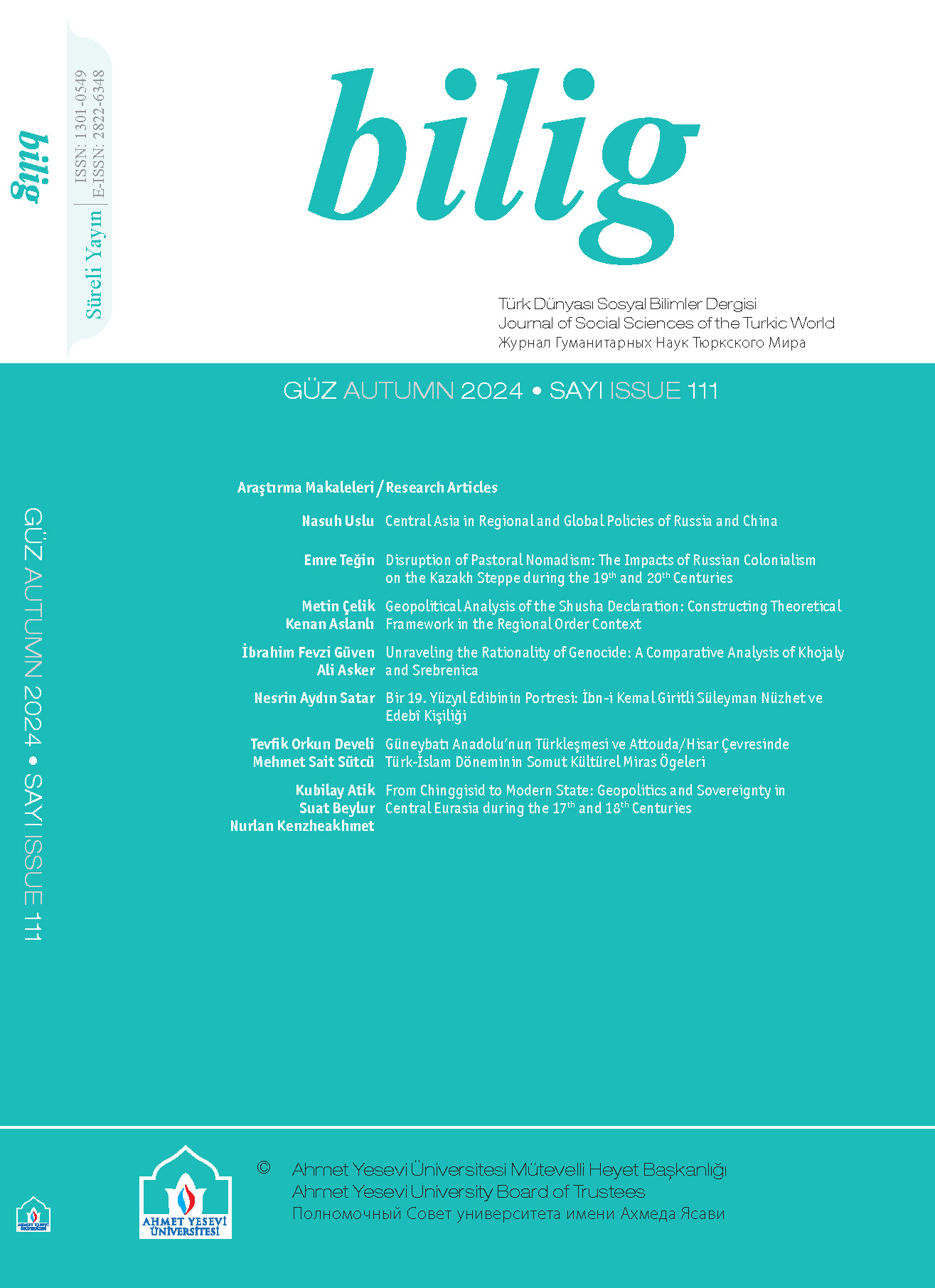
- Autumn 2024
Contents
7 itemsResearch Article
- pp. 1–27
-
Disruption of Pastoral Nomadism: The Impacts of Russian Colonialism on the Kazakh Steppe during the 19ᵗʰ and 20ᵗʰ Centuries doi.org/10.12995/bilig.11102pp. 29–53
-
Geopolitical Analysis of the Shusha Declaration: Constructing Theoretical Framework in the Regional Order Context doi.org/10.12995/bilig.11103pp. 55–78
-
Unraveling the Rationality of Genocide: A Comparative Analysis of Khojaly and Srebrenica doi.org/10.12995/bilig.11104pp. 79–102
-
Bir 19. Yüzyıl Edibinin Portresi: İbn-i Kemal Giritli Süleyman Nüzhet ve Edebî Kişiliği doi.org/10.12995/bilig.11105pp. 103–123
-
Güneybatı Anadolu’nun Türkleşmesi ve Attouda/Hisar Çevresinde Türk-İslam Döneminin Somut Kültürel Miras Ögeleri doi.org/10.12995/bilig.11106pp. 125–157
-
From Chinggisid to Modern State: Geopolitics and Sovereignty in Central Eurasia during the 17th and 18th Centuries doi.org/10.12995/bilig.11107pp. 159–192