
Foreword
Dear Readers,
We present you the new issue of bilig.
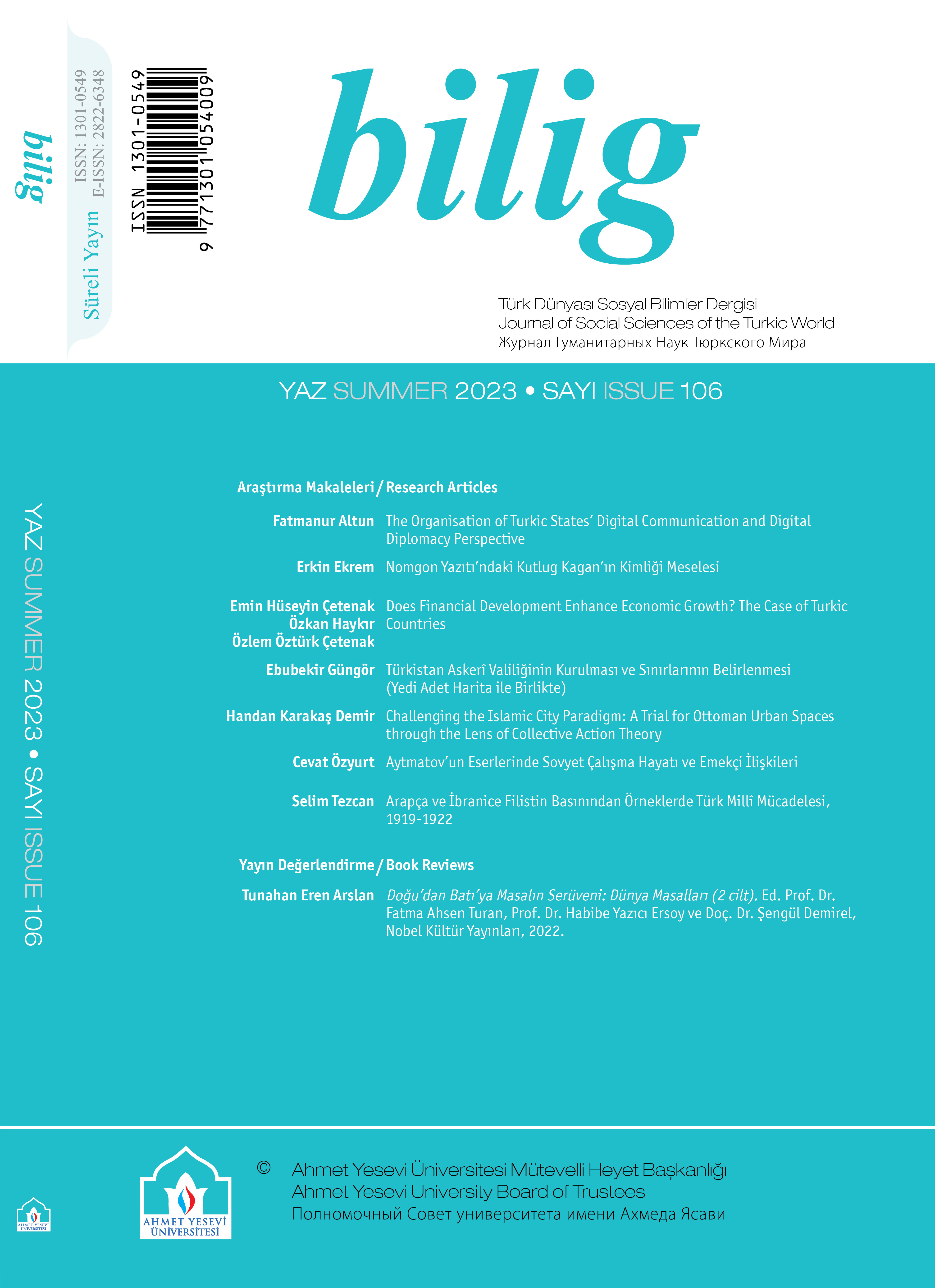
In this issue, there are seven articles and a book presentation on different topics related to the current issues and cultural richness of the Turkic world.
Fatmanur Altun’s article deals with the digital communication and digital diplomacy perspective of the Organization of Turkic States, the umbrella organization for the integration of the Turkic world, and focuses on the opportunities offered by digital diplomacy for Turkic states in the rapidly digitalizing world and the organization’s work in this field.
Erkin Ekrem, on the other hand, analyzes the Nomgon Inscription that was found on August 24, 2022, as a result of excavations carried out by the International Turkic Academy (TWESCO) and the Archeology Institute of the Mongolian Academy of Sciences. In his article titled “Identity of Kutlug Khagan in the Nomgon Inscription”, Ekrem, who extensively uses the Chinese sources, claims that the person described in the inscription is not Ilteriş Khagan, the founder of the II. Göktürk Khaganate, but his brother and the second khagan Kapgan Khagan.
The third article, which discusses the relationship between financial development and economic growth through the examples of Turkic republics, reveals the positive correlation between financial development and economic growth by Azerbaijan, Kazakhstan, Kyrgyzstan and Turkiye’s data from 1995 to 2017.
In the article titled “The Establishment of the Turkestan Military Governorate and Determination of Its Boundaries (with seven maps)” written by Ebubekir Güngör, the boundaries that the Turkestan Military Governorate reached till the beginning of the 20th century with the establishment and expansion of it are described. The author mapped the region by drawing it in the Geographic Information System ArchGis ArcMap 10.5 program. While drawing these maps, the writer benefited from the Nizamname, Emirname, Kanunname, the details on the borders in the statistics, the Turkestan map of 1884 that belongs to Turkish General Staff, and waterways and today’s border data. The data in the sources has been tried to be determined by comparing the map of 1884 and the borders of modern administrative unit.
Shortly, as seen in the articles briefly introduced, bilig is a scientific journal with a specific and a rather wide scope focusing on the Turkic world and covering studies from different branches of social sciences such as history, communication, economics, and geography. This creates advantages and difficulties together. Accepting articles from all branches of social sciences presents opportunities and also handicaps. Although bilig focuses on Turkic world, publishing articles from a wide range of disciplines may cause distraction. Our unchanging priority is being the first reference source that comes to mind for academics studying the Turkic world.
The Journal Citation Report for Web of Science Journals was published by Clarivate on June 28, 2023. As seen in the graphics above, bilig’s impact factor has decreased compared to the precious year. On the other hand, our journal continued to be indexed in the Field Studies category in SSCI and maintains its stability. As the editorial board, in spite of aiming to increase our impact factor, such a decline has saddened us. However, by taking lessons from this, we will try to increase the experience sharing and cooperation initiatives that will improve the quality of editorial, authorship and refereeing processes. We believe that we will positively change this figure next year. We sincerely believe that you, as writers and referees, will support our efforts.
I wish the best for new issue and pay my respect.
Prof. Dr. Fırat PURTAŞ
Editor in Chief
Issue Details
- Issue
- 106
- Published
- Articles
- 8
- Period
- Summer 2023
Contents
8 itemsResearch Article
-
The Organisation of Turkic States’ Digital Communication and Digital Diplomacy Perspective doi.org/10.12995/bilig.10601pp. 1–33
- pp. 35–54
-
Does Financial Development Enhance Economic Growth? The Case of Turkic Countries doi.org/10.12995/bilig.10603pp. 55–76
-
Türkistan Askerî Valiliğinin Kurulması ve Sınırlarının Belirlenmesi (Yedi Adet Harita ile Birlikte) doi.org/10.12995/bilig.10604pp. 77–107
-
Challenging the Islamic City Paradigm: A Trial for Ottoman Urban Spaces through the Lens of Collective Action Theory doi.org/10.12995/bilig.10605pp. 109–144
- pp. 145–172
-
Arapça ve İbranice Filistin Basınından Örneklerde Türk Millî Mücadelesi, 1919-1922 doi.org/10.12995/bilig.10607pp. 173–198
Book Review